
Catering Checklist for Delaware Events
March 3, 2026
A great event meal feels effortless to guests. Behind the scenes, it’s anything but.
Delaware events come with real-world constraints that can make or break your catering: venue rules that dictate where you can cook, coastal weather that changes the service style, permitting timelines that don’t care about your RSVP drama, and alcohol service details that can become a compliance headache if you discover them too late.
That’s why a structured catering checklist for Delaware events matters. It turns a complicated, moving target into a clear plan: what to decide, what to confirm, what to document, and when to lock it all in—so your food is memorable for the right reasons.
If you’re planning a wedding, corporate gathering, nonprofit fundraiser, private party, or community event, this guide is built like an event professional’s playbook: practical, scannable, and focused on the details that actually matter.
Quick-start summary for busy readers
If you only have 5 minutes, use this as your fast path. Then come back and work through the full Delaware event catering checklist section-by-section.
Decide early (weeks/months out):
- Confirm guest count range and service style (buffet vs plated vs stations).
- Confirm venue restrictions (kitchen access, open flame, load-in times, trash rules, preferred vendors).
- Set your realistic per-person budget (food, labor, rentals, bar, fees, gratuity, contingency).
Lock compliance and logistics (4–8 weeks out):
- Ask your caterer what permits/approvals apply for your event type and location.
- Confirm food safety plan for transport, hot/cold holding, and outdoor service.
- For alcohol: confirm who holds the alcohol license/permit and what approvals are required for off-site service.
Finalize execution (30 days to event week):
- Final menu with dietary accommodations and allergen labeling plan.
- Staffing plan and event-day timeline (prep, arrivals, service, cleanup).
- Confirm rentals, power, refrigeration, waste removal, and rain/wind plan.
Day-of focus:
- Have a master checklist and one point person to coordinate caterer + venue + rentals + bar.
- Keep food safety and guest flow top of mind—especially outdoors.
Pre-event planning fundamentals that drive every catering decision
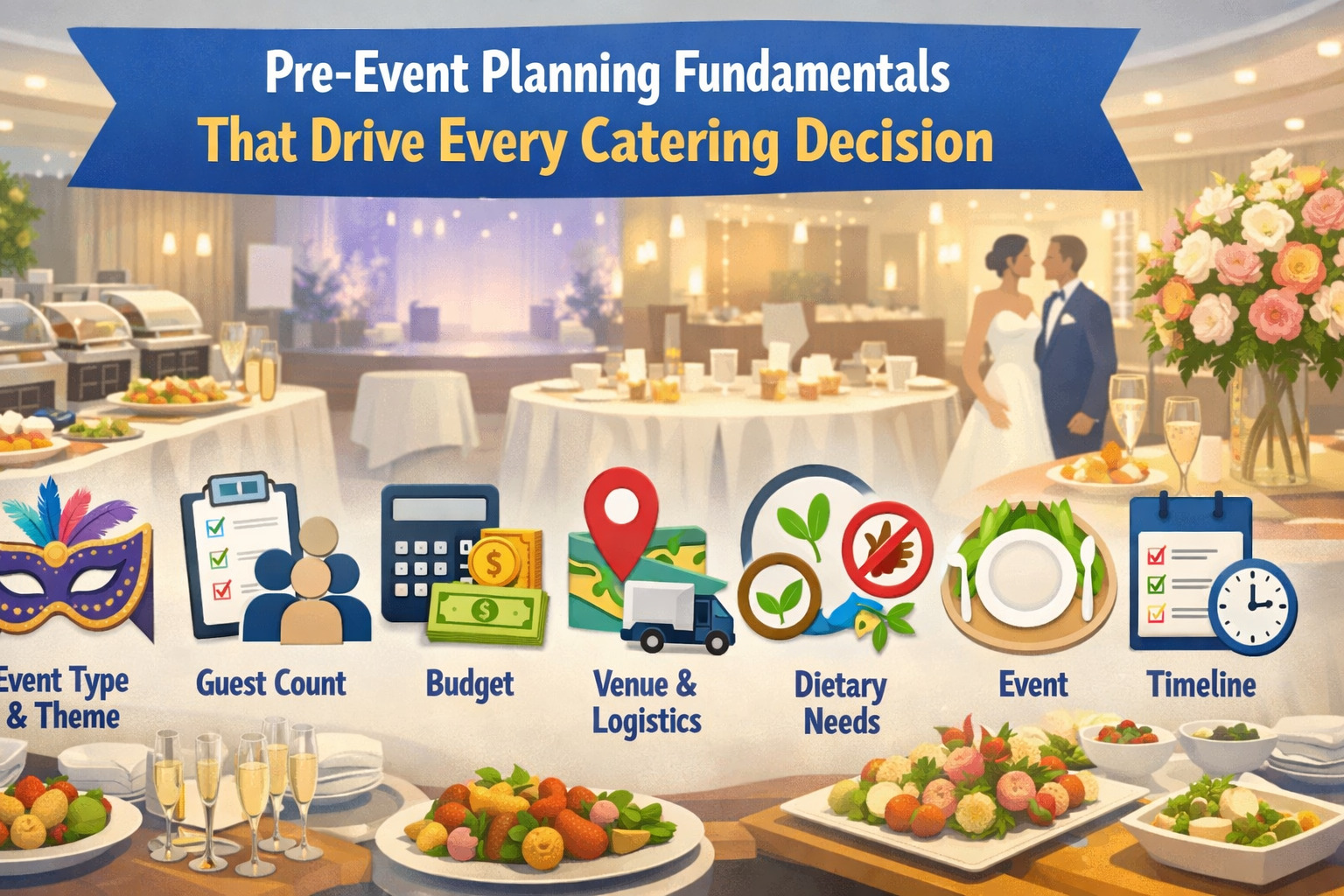
Before you compare menus or negotiate pricing, you need three anchors: guest count, venue constraints, and budget. These decide everything from staffing ratios to whether your caterer can safely execute your menu.
Start with guest count ranges, not perfection. Plan in tiers:
- Expected count (your most likely)
- Low/High range (for budgeting and ordering)
- Guaranteed minimum (often needed for contracts)
Then translate guest count into a service model. Buffet, plated, stations, family-style, cocktail heavy hors d’oeuvres—each requires different equipment, staffing, and time. A plated dinner with multiple courses can be stunning, but it’s sensitive to timing and staffing. A buffet can be efficient, but it requires guest flow planning and food temperature management.
Next, map out what the venue will and won’t allow:
- Can you cook onsite, or must food arrive fully prepared?
- Are there restrictions on open flame, fryers, propane, or grilling?
- Where is the loading zone, and how long is load-in allowed?
- Is there a required vendor list, COI requirements, or union labor rules?
Finally, set a budget that reflects reality:
- Food and beverages (including nonalcoholic drinks)
- Labor (setup, service, cleanup, chefs, bartenders)
- Rentals (tables, chairs, linens, glassware, flatware, hot boxes, tents)
- Fees (delivery, service charge, admin, travel)
- Contingency (typically 5–10% for changes and surprises)
Venue coordination: rules, layouts, and communication that prevent surprises

Venues in Delaware vary widely: historic properties, beaches, barns, ballrooms, private clubs, corporate offices, and public parks all have different operational realities. Your catering plan should start with the venue’s rulebook—written and unwritten.
Ask for venue policies in writing, then review them with your caterer. Key items to confirm:
- Kitchen access: Is there a commercial kitchen? A warming kitchen? Or no kitchen at all?
- Power availability: Number of circuits, outlet locations, generator rules, noise limits.
- Water access: Handwashing station requirements, potable water access, gray water disposal.
- Trash and recycling: Who provides bins, liners, and haul-away? Any sorting rules?
- Load-in/load-out: Elevator access, stairs, ramp availability, timing restrictions, parking.
- Noise and curfew: Impacts bar service and late-night snacks.
- Floor plan constraints: Fire lanes, tent placement, buffet/station placement, ADA access.
Layouts matter more than most hosts expect. A buffet placed in the wrong location can create lines that block doors, disrupt speeches, or cause crowding near the bar. A plated service requires staging space for plates and servers. Stations need spread-out power and traffic planning.
Use a simple “catering footprint” map with:
- Prep/staging area
- Beverage station(s)
- Bar placement
- Buffet/stations placement
- Bussing station (dirty dish landing zone)
- Trash location
- Staff entry/exit
Catering requirements for events in Delaware: what to verify early

This section is designed to help you plan responsibly without turning your event into a legal research project. Catering compliance often depends on where you’re serving, how long you’re operating, and what you’re doing onsite (cooking, reheating, alcohol, tents, etc.).
When in doubt, your best move is to confirm requirements with the right authority and document what you learned.
Food safety considerations and health department approval
Food safety isn’t just a caterer concern—it’s an event host concern, too, because delays or unsafe holding conditions can derail service.
For events that function like a temporary food operation, Delaware guidance describes temporary operations as limited-duration event food service. Delaware’s Business First Steps page notes that temporary permits are for operations “up to 14 days,” and that applications must be submitted at least 10 days prior to the event.
That means your timeline matters. Even if your caterer is handling the paperwork, you should confirm:
- Whether your event location or format triggers a temporary food permit
- Whether the caterer’s existing licensing covers the event
- What onsite requirements apply (handwashing, sanitation, temperature control)
Food safety items to confirm with your caterer:
- Hot holding plan (how hot food stays hot during transport and service)
- Cold holding plan (ice baths, refrigeration, insulated coolers)
- Allergen separation and labeling plan
- Leftover handling plan (what is discarded vs packaged; who is responsible)
Permits, venue approvals, and local authority coordination
Delaware isn’t one single jurisdictional experience. Cities and towns may have their own event rules, and certain venues (historic sites, parks, waterfront areas) may require additional approvals.
Your coordination checklist:
- Confirm the venue’s required approvals (and deadlines)
- Confirm whether the event needs a local permit (street closures, noise, tents, cooking equipment)
- Confirm who is responsible for each submission (host, venue, caterer, planner)
For tents and temporary structures, Delaware’s State Fire Marshal provides a tent permit process and application pathway.
If your event is in a city-managed facility or public space, confirm whether the city requires additional fire permits for cooking equipment, generators, or propane. (Many municipalities publish vendor checklists and fire safety requirements for events.)
Alcohol service considerations: licensing, approvals, and contracts
If alcohol is part of your plan, clarify who is legally providing it and how it will be served:
- Venue-provided bar (common at clubs and ballrooms)
- Caterer-provided bar (if licensed to do so)
- Separate licensed bar vendor
- Host-provided alcohol (often restricted by venue and event type)
Delaware’s Alcoholic Beverage Control Commissioner (OABCC) provides forms and application materials, including information relevant to on-premises retail licensing used by establishments such as restaurants and caterers.
For off-site catered events, Delaware Administrative Code includes specific rules—such as the event being tied to a written contract, potential allowance of a cash bar alongside a catered event, and an approval timeline (the rule text notes event approval no later than 20 days prior, along with submission items).
Key planning questions:
- Who holds the alcohol license/permit for this event?
- Is a cash bar allowed at this venue and for this event type?
- Are there restrictions on self-serve alcohol, BYOB, or champagne walls?
- What are the ID-check and underage prevention procedures?
Event catering compliance checklist Delaware
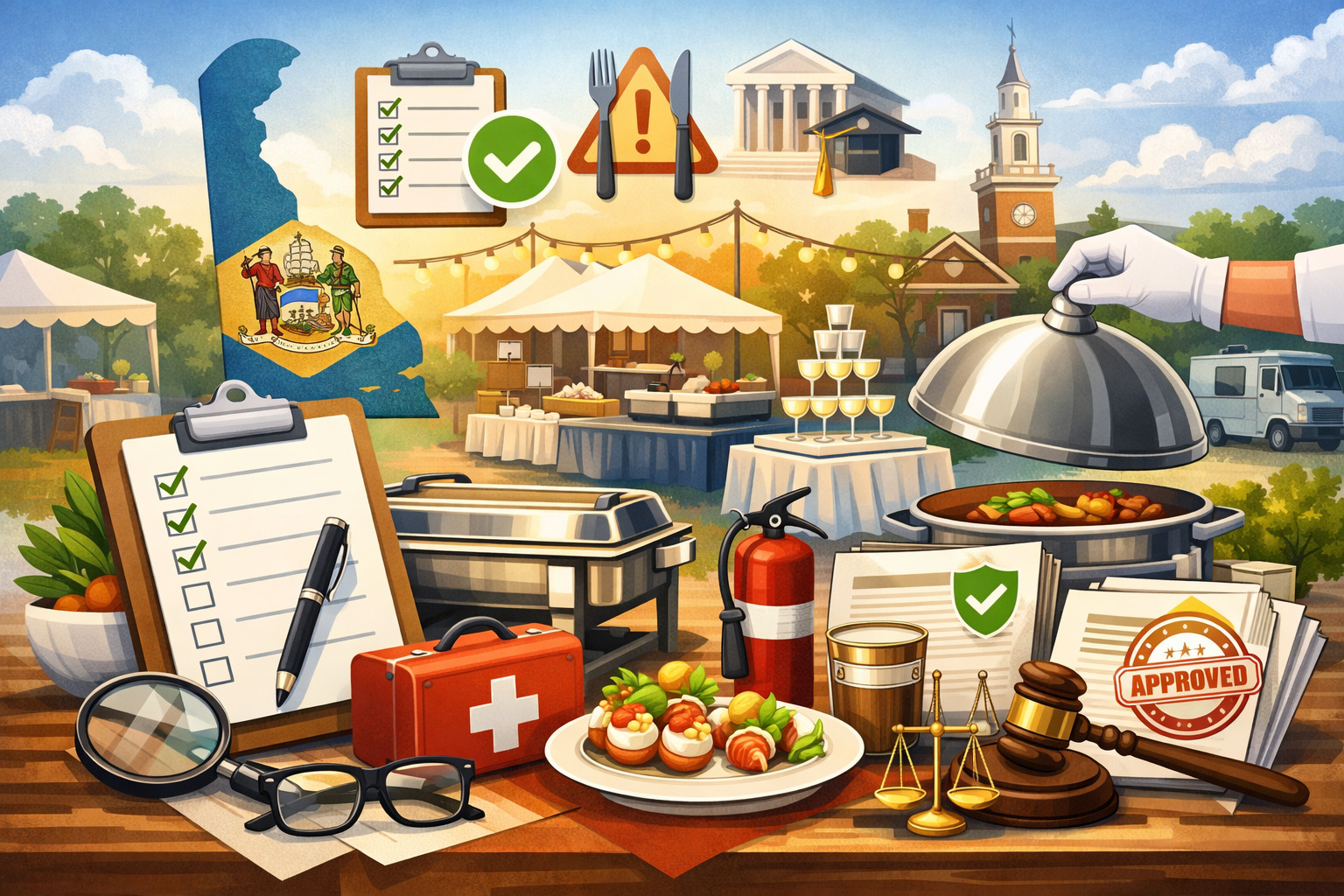
Use this event catering compliance checklist Delaware section as your working document. It’s written so you can copy/paste it into your planning notes and mark items complete.
Compliance and documentation checklist
Food and health department coordination
- Confirm whether the event qualifies as a temporary food service operation and what that implies.
- Confirm whether your caterer’s licensing/permits cover your specific location and format.
- Confirm the application timeline and who submits it (host/planner/caterer).
- Confirm onsite sanitation requirements: handwashing, dishwashing approach, waste water disposal.
- Confirm food temperature control plan for transport + holding + service.
Venue approvals
- Get venue rules in writing (kitchen use, flame/propane, load-in times, trash rules).
- Confirm required insurance levels and certificate of insurance (COI) wording.
- Confirm whether the venue requires a specific security plan for alcohol.
- Confirm venue staffing requirements (security, building engineer, attendant).
Fire and safety
- If using a tent, confirm whether a tent permit is required and submit on time.
- If using cooking equipment outdoors, confirm local fire safety requirements (extinguishers, generator placement, propane rules).
- Confirm egress routes are not blocked by buffet lines, bars, or décor.
- Confirm generator plan: placement, fuel storage, sound constraints, weather protection.
Alcohol service rules
- Confirm who holds the alcohol license/permit and whether off-site approval is required.
- Confirm the event is covered by a written catering/bar contract where applicable.
- Confirm ID check process and who is responsible.
- Confirm last call timing and venue curfew.
- Confirm transportation/waybill process if alcohol is transported by the licensed provider.
Vendor selection checklist: how to choose the right caterer (and avoid costly mismatches)
A caterer can be talented and still be wrong for your event. The right fit depends on your guest experience goals, venue constraints, and operational complexity.
Start by filtering for real capability:
- Do they regularly execute events at your size and style?
- Can they handle your service model (plated, stations, cocktail, buffet)?
- Can they support your location (beach, park, office building, historic property)?
- Do they provide rentals and staffing, or do you need separate vendors?
Questions to ask caterers during calls and tastings
Ask questions that reveal their operational thinking—not just menu creativity.
Operations and logistics
- How do you keep hot foods hot and cold foods cold during transport and service?
- What’s your plan if we lose power or weather shifts unexpectedly?
- Who is the day-of lead, and how many events do they manage at once?
- What’s your typical load-in time requirement?
Staffing and service
- What staffing ratios do you recommend for our service style?
- Do you staff bartenders, bussers, and a floor captain?
- How do you manage guest flow for buffet or stations?
Compliance and insurance
- What permits or approvals do you typically handle for events like ours?
- Can you provide COI showing general liability and (if applicable) liquor liability?
- If alcohol is served, who is responsible for licensing/permits and approvals?
Food and guest experience
- How do you accommodate allergies and dietary restrictions without isolating guests?
- Do you label allergens on buffets/stations?
- What’s included in tastings (and is it credited back if we book)?
Contract and proposal review checklist
Before you sign, ensure the proposal clearly states:
- Menu and portion standards (not just “passed apps”)
- Service style and staffing counts
- Rentals included vs excluded
- Setup and breakdown scope
- Taxes/fees/service charges/gratuity policy
- Payment schedule and cancellation terms
- Overtime rates and what triggers them
- Guest count deadline and overage policy
- Weather plan for outdoor events
- Responsibility matrix (who does what: host/venue/caterer)
Menu planning that feels thoughtful: dietary needs, allergens, and seasonal strategy
A great menu is not just delicious—it’s designed. It accounts for timing, temperature, guest flow, dietary restrictions, and seasonality.
Dietary restrictions and allergen planning
Delaware events often have a mix of guests: families, corporate teams, community groups, and multi-generational wedding parties. A menu that ignores dietary needs can create awkward moments, medical risks, and wasted spend.
Build a process:
- Collect dietary needs with RSVPs (and ask for severity of allergies).
- Categorize: allergy (medical), intolerance, preference.
- Decide on a labeling system for buffets/stations.
- Identify cross-contact risks (especially nuts, gluten, shellfish).
Practical ways to keep everyone included:
- Offer at least one satisfying main option that is naturally free of common allergens (not just salad).
- Create one “safe plate” pathway handled by a trained staff member.
- Avoid hidden allergens (sauces, garnishes, finishing oils).
- For plated meals, use color-coded place cards or seating chart notes for dietary plates.
Seasonal menu planning and local venue realities
Seasonality is about more than ingredients—it’s about conditions. Outdoor heat changes what holds well. Wind changes what can be served elegantly. Cooler months affect guest comfort and beverage choices.
Seasonal strategy examples:
- Warm weather: lighter sauces, sturdy greens, fewer mayonnaise-forward dishes outdoors.
- Cooler months: braised proteins, soups in cups, warm bread service, hot cocoa/coffee bar.
- Shoulder season: flexible menus that can pivot indoors/outdoors.
Also consider the venue:
- No kitchen: choose items that travel and hold well; avoid last-minute frying.
- Limited power: reduce dependence on electric warmers; use insulated holding equipment.
- Tight load-in: simplify courses; choose faster plating and fewer last-minute garnishes.
Buffet vs plated service: choosing the right format for your Delaware event
This decision has a bigger impact than most hosts realize. It changes staffing, timeline, rentals, food quantities, and guest experience.
Buffet service: best for flexibility, but requires flow control
Buffets can feel abundant and social, and they typically reduce per-guest labor costs. But they require intentional layout and temperature control.
Buffet checklist:
- Plan guest flow (two-sided buffet or multiple stations for larger groups).
- Avoid bottlenecks near doors, bars, or seating aisles.
- Assign staff to refresh food, clean spills, and manage utensils.
- Use clear allergen labeling and separate serving utensils.
- Confirm hot holding equipment capacity and power needs.
Buffet works well for:
- Nonprofit events where mingling matters
- Family-style celebrations
- Corporate events with flexible timing
Risks to manage:
- Longer lines if under-stationed
- Temperature drift if food sits too long
- Accessibility needs (height, mobility, assistance)
Plated service: elevated experience, but demands precision
Plated service feels formal and seamless—when staffing and timing are right. It’s sensitive to schedule delays, because your kitchen and service team are operating on a tight sequence.
Plated checklist:
- Confirm kitchen/staging space and plating area.
- Confirm staffing: servers, runners, captain, bussers.
- Confirm dietary plate tracking method.
- Build extra buffer time for speeches, first dances, or awards.
- Confirm timing between courses and how you’ll handle late guests.
Plated works well for:
- Weddings with a structured program
- Corporate galas and donor dinners
- Events where speeches need a quiet room
Risks to manage:
- Understaffed service causes slow or uneven pacing
- Tight venue rules may limit plating or reheating options
- Menu complexity increases execution risk
Alcohol and bar service planning: experience, safety, and smart control
Bar service is part hospitality, part logistics, part risk management. Your job is to create a great experience while keeping service controlled and compliant.
First, decide the bar model:
- Hosted open bar: best guest experience, highest cost.
- Limited bar: beer/wine + one signature cocktail.
- Cash bar: can reduce host cost but may be restricted by venue or event type; clarify early.
- Ticketed bar: controlled spend; guests exchange drink tickets.
For off-site catered events, Delaware rules include contract-based expectations and an approval timeline in the administrative code for off-site catered events.
Bar planning checklist
Experience
- Choose a drink menu that matches the event: crowd-pleasing, fast to serve.
- Plan nonalcoholic options that feel intentional (not just soda).
- Decide last call timing and communicate it subtly.
Operations
- Confirm bartender count based on guest count and bar complexity.
- Confirm glassware vs disposable; plan for backups.
- Confirm ice quantities (you almost always need more).
- Confirm bar layout: speed rails, garnish station, trash, bus tubs.
Safety and control
- Confirm ID check process and who performs it.
- Confirm how the team handles visibly intoxicated guests.
- Confirm transportation plan (rideshare codes, shuttle, designated driver messaging).
- Confirm liquor liability insurance where applicable.
Logistics planning for Delaware events: rentals, power, refrigeration, and coastal weather
Logistics is where catering goes from “menu” to “execution.” This is especially true for outdoor event catering, beach-adjacent venues, and any location without a full kitchen.
Rentals and equipment checklist
Confirm what your caterer provides vs what you must rent:
- Tables/chairs/linens
- Plates/flatware/glassware
- Serving ware: chafers, platters, utensils
- Beverage dispensers, coffee service equipment
- Handwashing station (if required)
- Lighting for buffet/stations and prep zones
- Trash cans, liners, and recycling bins
- Tent, flooring, fans/heaters depending on season
Ask vendors about delivery windows, setup responsibility, and pickup timing. Align all schedules so your space isn’t overloaded with separate drop-offs that block each other.
Power, refrigeration, and safe holding
If your menu requires refrigeration or hot holding, you need an equipment plan—not hope.
- Confirm refrigerated storage (onsite fridge space or rented refrigeration).
- Confirm hot holding (hot boxes, insulated cambros, chafers, warmers).
- Confirm generator needs if power is limited, and protect cords from foot traffic.
For tented events, confirm whether a tent permit is needed and what inspections apply.
Rain, wind, and coastal considerations
Delaware weather can change quickly, and coastal winds are not polite.
Plan for:
- Wind: weighted tent legs, protected buffet covers, heavier décor, secure signage.
- Rain: covered pathways for staff carrying food; protected prep zones.
- Heat: shade, fans, faster turnover for cold items, additional ice.
- Cold: warm beverages, covered service, heaters if allowed.
Staffing and service planning: event staffing ratios that feel smooth
Guests don’t remember your staffing spreadsheet. They remember whether they had to hunt for water, wait too long for food, or step around overflowing trash.
Staffing needs vary by service style, but your plan should cover these roles:
- Event captain/floor lead: runs timing and guest flow.
- Kitchen lead/chef: oversees food execution.
- Servers: plated service, stations, passed apps.
- Bartenders: bar service, restocking, ID checks.
- Bussers: clearing, resetting, trash management.
- Runner/support: restocking stations, moving items, solving problems.
Staffing planning checklist
- Define the service style and pace (fast cocktail vs formal plated).
- Confirm staffing counts in writing, including captain/lead.
- Confirm setup and breakdown labor is included (not just “service during event”).
- Confirm who handles water service and coffee service.
- Confirm who manages trash, recycling, and back-of-house cleanliness.
- Build buffer staffing if the venue has stairs, long carries, or limited access.
Budgeting and contract review checklist: protect the experience and your finances
Catering budgets can drift quietly. A few upgrades, an expanded bar, rental additions, and overtime can balloon costs.
Catering budget categories to track
- Food (apps, dinner, dessert, late-night)
- Nonalcoholic beverages
- Alcohol and bar labor
- Staffing and service labor
- Rentals and delivery fees
- Venue-required labor (security, building engineer)
- Taxes/fees/service charges
- Gratuity policy
- Contingency
Contract review checklist
Before signing:
- Confirm the menu is specific (counts, portions, brands if important).
- Confirm staffing numbers and roles.
- Confirm rental list line-by-line.
- Confirm timeline assumptions (when food must be served, not just “event time”).
- Confirm overtime trigger points and hourly rates.
- Confirm guest count deadline (and what happens if you exceed it).
- Confirm payment schedule and refund/cancellation terms.
- Confirm responsibility for leftover food and packaging.
- Confirm insurance requirements and COI delivery date.
90/60/30/7-day catering planning timeline breakdown
Use this catering timeline to stay ahead of deadlines and avoid last-minute stress.
90 days out: set the foundation
- Confirm guest count range and budget target.
- Select the caterer and lock the date with a deposit.
- Confirm venue rules and load-in/load-out plan.
- Decide service style (buffet vs plated vs stations).
- Decide alcohol approach and who provides bar service.
- Identify rentals you’ll need and any power/tent requirements.
60 days out: confirm compliance and logistics
- Confirm which permits/approvals apply and who is responsible.
- Confirm tent permit process if needed.
- Confirm menu direction and schedule tasting.
- Confirm rentals and preliminary floor plan.
- Confirm staffing approach and service timeline.
- Confirm bar plan and licensing/approval needs.
30 days out: finalize details that impact execution
- Finalize menu with dietary accommodations and allergen plan.
- Confirm final rental order (with 5–10% buffer on glassware).
- Confirm power, refrigeration, and waste plan.
- Confirm staffing numbers and event captain contact.
- Confirm printed signage needs (menu, allergens, bar options).
- Confirm rain/wind plan and decision trigger date.
7 days out: tighten the screws
- Provide final guest count (or confirm deadline).
- Confirm timeline: load-in, setup, service, breakdown, pickups.
- Confirm vendor COIs are delivered to venue.
- Confirm final payments and gratuity plan.
- Confirm day-of contacts list and communication method (group text).
- Confirm dietary list and seating notes.
Detailed day-of-event master checklist
This is the master list event professionals use to keep catering smooth and guests happy.
Before caterer arrival
- Confirm venue access and keys/entry process.
- Confirm load-in path is clear and elevator reserved if needed.
- Confirm power access and any reserved circuits.
- Confirm rain plan is ready to implement (tent sides, indoor backup).
- Confirm signage plan and where it will be placed.
During setup
- Confirm catering staging area and bussing station location.
- Confirm buffet/stations placement and guest flow.
- Confirm bar placement, ice storage, and trash placement.
- Confirm handwashing/sanitation setup if applicable.
- Confirm allergy-friendly pathway and labeling.
Pre-service checks
- Taste one bite of each key menu item (quality check).
- Confirm hot foods are held hot and cold foods are held cold.
- Confirm water stations are filled and visible.
- Confirm staffing is in position before guests enter.
- Confirm timeline cues: speeches, first dance, awards, program moments.
Service and guest experience
- Monitor lines at buffet/stations; adjust flow if needed.
- Confirm staff is resetting tables and clearing discreetly.
- Confirm trash is being managed before it becomes visible.
- Confirm dietary plates are delivered correctly and confidently.
- Confirm bar pace stays smooth; adjust staffing if lines grow.
Cleanup and breakdown
- Confirm leftover handling plan (what can be packaged; what must be discarded).
- Confirm rentals are consolidated for pickup.
- Confirm venue trash/recycling rules are followed.
- Confirm nothing is left behind in kitchen/staging areas.
- Do a final walk-through with venue rep.
Post-event wrap-up checklist: close the loop professionally
Post-event steps protect your deposit, your relationships, and your sanity.
- Confirm final invoice accuracy (overtime, extra rentals, added guests).
- Tip/gratuity distribution (if not included) and confirm who receives it.
- Collect COI and permit records into your event folder for future reference.
- Document what worked and what didn’t (menu, staffing, flow).
- Save vendor contacts and notes for next time.
- Leave reviews for vendors who performed well (it helps the local ecosystem).
- Send thank-you notes to key vendor contacts and venue staff.
Common mistakes to avoid (and what experienced planners do instead)
Even well-organized hosts make predictable mistakes. Here’s what to watch for.
Mistake 1: Choosing a menu that doesn’t match the venue
What happens: Beautiful dishes that require onsite finishing… at a venue with no kitchen and limited power.
Do instead:
- Choose dishes designed for transport and holding.
- Ask your caterer what items are “high risk” for your venue and season.
Mistake 2: Underestimating rentals and smallwares
What happens: Not enough water glasses, serving utensils, or coffee cups—forcing last-minute scrambling.
Do instead:
- Use a rental checklist tied to your menu and bar plan.
- Add buffers for glassware and ice.
Mistake 3: Not planning guest flow
What happens: Buffet line blocks entrances, bar line blocks the stage, stations crowd the dance floor.
Do instead:
- Map guest paths before you place food and bars.
- Use multiple smaller stations for larger crowds.
Mistake 4: Treating compliance as “the caterer’s problem”
What happens: A last-minute issue with approvals, tents, or alcohol responsibilities disrupts the event.
Do instead:
- Use the event catering compliance checklist Delaware section and assign owners/dates.
- Confirm submission deadlines early (some approvals require meaningful lead time).
Mistake 5: Not building time buffers
What happens: Speeches run long, service starts late, food quality suffers.
Do instead:
- Build schedule buffers for real life.
- Reduce menu complexity if the program is timing-heavy.
FAQ
Q1) What’s the first step in a catering checklist for Delaware events?
Answer: Start with guest count range, venue rules, and budget. Those three decisions determine service style, staffing, rentals, and what’s realistically executable at your location.
Q2) How early should I book a caterer for a Delaware wedding or corporate event?
Answer: For peak season weekends and popular venues, booking earlier is safer—especially if you need a full-service team plus rentals and bar. If you’re inside a tight timeline, focus on caterers who already have infrastructure and staffing depth.
Q3) Do all events require catering permits?
Answer: Not necessarily. Requirements can depend on event type, location, and what food operations happen onsite. Delaware resources describe temporary food establishment permits for limited-duration operations and include application timing considerations.
Q4) What’s the best way to handle food safety for outdoor event catering?
Answer: Design the menu for safe holding: minimize high-risk cold items in heat, use insulated transport, plan shade and ice, and confirm hot holding equipment capacity. Ask your caterer for their specific transport and holding plan.
Q5) How do I choose between buffet vs plated service?
Answer: Buffet is flexible and often more cost-efficient but needs strong flow control and temperature management. Plated feels elevated but demands tighter timing, more staff, and staging space. Let your venue constraints guide the decision.
Q6) What should I ask a caterer during a tasting?
Answer: Ask operational questions, not just flavor questions: holding methods, staffing ratios, rain plan, dietary accommodations process, and exactly what is included in service and rentals.
Q7) How do I plan for dietary restrictions and allergens?
Answer: Collect needs early, categorize by severity, require a clear labeling plan, and confirm how dietary plates are tracked and delivered. Avoid vague promises—get the process.
Q8) Can a caterer provide alcohol service at an off-site event?
Answer: It depends on licensing/approvals and event structure. Delaware’s Alcoholic Beverage Control Commissioner provides application materials, and Delaware’s administrative code includes specific provisions for off-site caterers and event approvals.
Q9) Do I need a tent permit for an outdoor event?
Answer: Some tented events may require permits or inspections depending on size and setup. Delaware’s State Fire Marshal provides a tent permit application pathway.
Q10) What staffing is “enough” for a smooth event?
Answer: It depends on service style and venue complexity. Plated service and passed hors d’oeuvres require more hands than a simple buffet. A captain/lead is one of the most valuable roles for keeping timing and quality consistent.
Q11) What should be in a catering contract?
Answer: Menu specifics, staffing counts, rentals, setup/breakdown scope, fees, payment schedule, cancellation terms, overtime rates, guest count deadlines, and responsibilities for alcohol and compliance items.
Q12) What’s the most overlooked item in a Delaware event catering checklist?
Answer: Power, refrigeration, and trash removal—especially outdoors or in venues without full kitchen infrastructure. These are the “unsexy” details that can derail service if ignored.
Conclusion
A successful event isn’t built on a great entrée alone. It’s built on clarity: clear guest counts, clear venue rules, clear compliance responsibilities, clear staffing, and a timeline that makes execution possible.
Use this catering checklist for Delaware events as your working system:
- Start with fundamentals (guest count, venue, budget)
- Confirm catering requirements for events in Delaware early and document responsibilities
- Choose a caterer based on operational fit—not just a pretty proposal
- Lock logistics, staffing, and a weather-ready plan
- Run a tight day-of checklist so guests only notice the hospitality—not the complexity