

Licensed Caterers in Delaware: What to Look For
March 3, 2026
Planning an event is equal parts excitement and risk management. The flowers can be late and the DJ can pivot. But if food safety slips, service collapses, or a venue rejects your vendor at the last minute, the fallout is immediate—and it’s the kind guests remember for the wrong reasons.
That’s why licensing and compliance matter so much when you’re hiring catering in Delaware. Licensed professionals tend to bring more than great menus: they bring inspected kitchen practices, trained staff, predictable logistics, and the paperwork venues often require before they’ll even allow a caterer on-site.
For weddings, corporate events, private parties, fundraisers, and community gatherings, “good food” is only one part of the job. The bigger job is delivering a smooth, safe, well-staffed experience that protects your guests, your venue relationship, and your budget.
Delaware is also a state where many events happen in spaces with specific operating rules—historic properties, waterfront venues, tented outdoor sites, corporate campuses, and community halls.
Each comes with its own constraints: limited kitchen access, restricted load-in times, tight parking, noise rules, fire code details for warming equipment, and strict cleanup expectations. A licensed, experienced caterer knows how to navigate those realities without turning your timeline into chaos.
This guide is built for real hiring decisions. If you’re comparing Delaware licensed catering services, you’ll learn what “licensed” can mean, what to verify, which documents to request, how to evaluate food safety and allergen standards, and how to choose a licensed caterer in Delaware with confidence—without getting buried in jargon or vague promises.
What “Licensed” Means in Catering (And Why It’s Not Always One Simple Thing)
In catering, the word “licensed” can mean a few different things, and those meanings don’t always show up clearly on a website or social media page. Many clients assume “licensed” is one universal credential, like a driver’s license.
In reality, licensing and compliance can involve multiple layers: business licensing, food establishment permitting, permitted kitchen use, and staff training.
At a minimum, a legitimate caterer typically operates as a registered business and can show proof of a business license. Beyond that, food preparation often ties to permits and inspections connected to a kitchen facility.
Some caterers cook in their own permitted kitchen. Others operate out of a commissary kitchen or partner with a permitted restaurant kitchen. The critical point is that food should be produced, stored, and transported under standards that support food safety compliance.
Requirements and enforcement can vary depending on where the kitchen is located, how food is prepared, and where it’s served. On top of that, many venues layer their own rules: they may require a certificate of insurance, specific coverage limits, bartender certification for alcohol service, or inclusion on a venue-approved vendors list.
Because of these moving parts, the most responsible approach is verification. Ask for documents, confirm where food is produced, and check venue rules early. If you’re planning Licensed caterers in Delaware events, you’re not just hiring food—you’re hiring a system that should stand up to inspections, venue oversight, and real-world pressure.
Delaware Catering License Requirements: What to Verify Without Getting Lost in Legalese
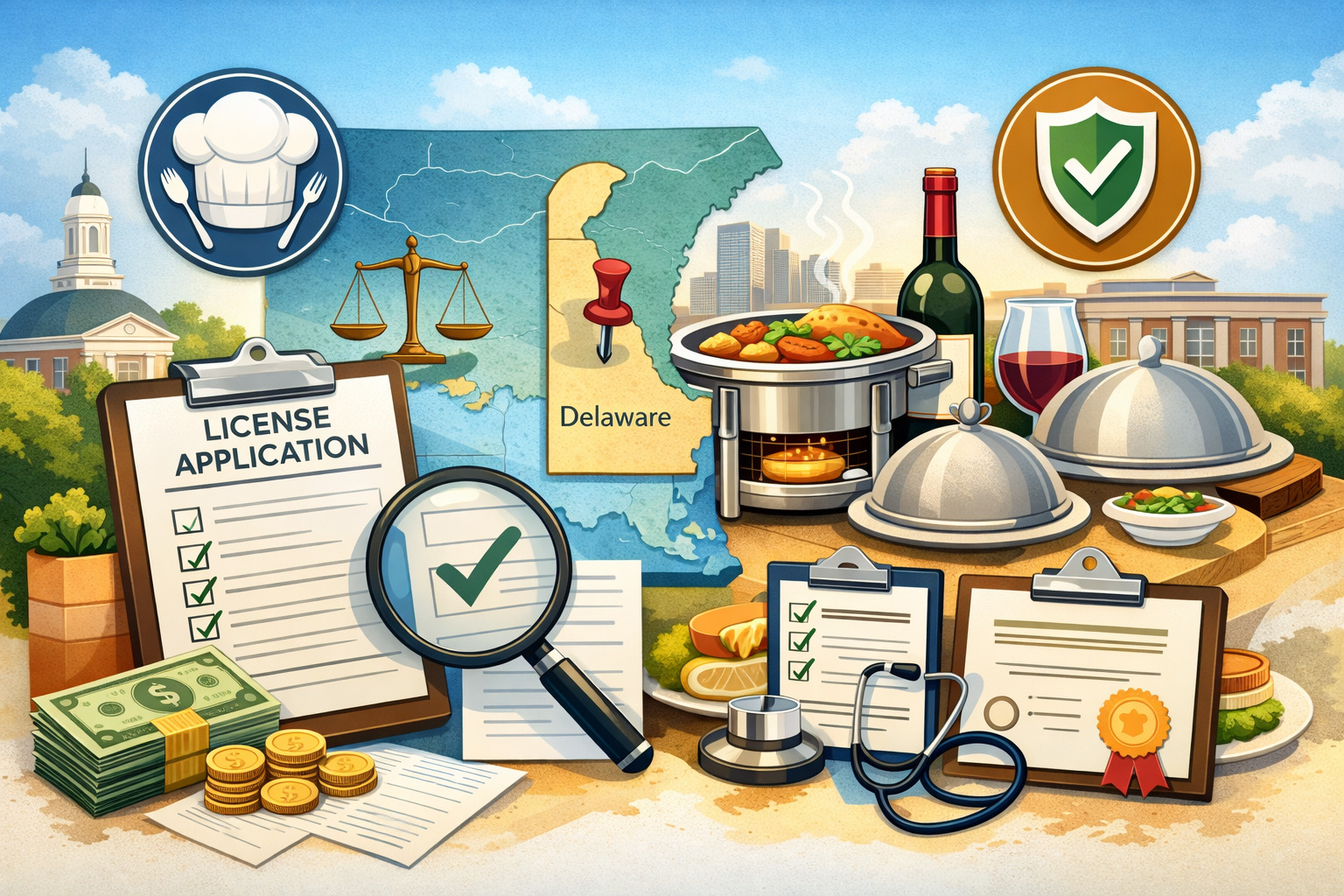
Most clients don’t want to become experts in regulations. You shouldn’t have to. But you do need a practical understanding of what to verify when hiring a certified caterer in Delaware, especially if your venue is strict or your event involves higher-risk food service (buffets, outdoor service, extended timelines, raw/undercooked items, or high-volume alcohol service).
Rather than relying on broad claims, approach Delaware catering license requirements as a verification checklist. A reputable caterer should be able to provide documentation that supports legitimate operations: proof they’re a real business, proof they operate from an appropriate kitchen, and proof they carry insurance.
They should also be able to describe their food safety procedures in plain language—temperature logs, transport methods, hot holding and cold holding equipment, and allergen protocols.
Here’s what you’re trying to confirm:
- They are a legitimate business with appropriate registration and a business license.
- They prepare food in a permitted kitchen (their own or a commissary kitchen arrangement).
- They follow safe production and transport practices aligned with health department expectations.
- They carry liability insurance and can provide a COI (certificate of insurance) with your venue listed as additional insured if required.
- They have trained staff (often supported by ServSafe or equivalent food safety training).
- They can operate within venue rules (load-in windows, kitchen access, open flame restrictions, cleanup requirements, waste removal, and alcohol service rules).
You don’t need to accuse anyone or “catch” them. You just need clarity. A professional will welcome these questions because they know you’re protecting your event.
How to Confirm a Caterer Is Legit: Documents, Questions, and Simple Cross-Checks

When people get burned by catering, it’s rarely because they didn’t ask about the menu. It’s because they didn’t confirm the behind-the-scenes basics. The good news is you can verify legitimacy without turning your process into a background investigation.
Start by requesting documents early—before you schedule tastings or sign anything. If a caterer can’t provide standard documentation promptly, you’re seeing how they’ll behave when you need last-minute answers later.
This step is especially important for Licensed caterers in Delaware events hosted at venues with strict vendor policies.
Documents to Request (Non-Negotiable Basics)
Ask for these items and keep them in a folder with your venue contract:
- Business license (or equivalent proof of legal business operation)
- Proof of permitted kitchen use (their own permitted kitchen paperwork, or a commissary kitchen agreement)
- Liability insurance certificate and COI (certificate of insurance) options
- Workers’ compensation proof if required by your venue
- Food safety credentials (ServSafe manager, food handler training, or comparable certifications)
- Alcohol service credentials if they’ll provide bartenders (bartender certification if applicable, plus proof of responsible service training if they use it)
A caterer doesn’t need to overshare personal information. But they should be able to provide professional proof they operate responsibly.
Simple Questions That Reveal a Lot
Ask these questions and listen to how specific the answers are:
- Where do you prep and store food before events?
- How do you maintain safe temperatures during transport? Do you use temperature logs?
- What’s your plan for hot holding and cold holding on-site?
- How do you handle allergens and special diets in a mixed-menu environment?
- Can you provide a COI naming my venue as additional insured?
- Who is the captain/lead on the event day, and what’s their experience level?
A real professional can answer smoothly without improvising. Vagueness is often your warning signal.
Step-by-Step: How to Choose a Licensed Caterer in Delaware
If you’re trying to choose a licensed caterer in Delaware, it helps to evaluate them like an event partner—not just a food provider. The best caterers manage risk, protect your timeline, and keep guests happy even when something goes sideways.
Here’s a decision framework I’ve used professionally when selecting caterers for different event types.
Step 1: Start With Your Event Reality, Not Just Your Guest Count
Before you even talk menus, clarify:
- Venue type (full kitchen, limited prep space, no kitchen)
- Service style (buffet, plated, stations, family-style, cocktail reception)
- Timing (how long food must be held safely; whether there’s a long gap between ceremony and dinner)
- Bar needs (beer/wine only, full bar, signature cocktails, cash bar rules)
- Staffing expectations (formal service vs casual drop-off)
- Outdoor risks (heat, wind, insects, rain plan, tent requirements)
When you share these details up front, you’ll quickly see who asks smart follow-up questions—and who just quotes a per-person price.
Step 2: Shortlist Based on Operations, Not Aesthetic
A beautiful Instagram feed doesn’t tell you if they own adequate hot boxes, have backup refrigeration, or can staff a 200-guest plated dinner without falling apart. Your shortlist should prioritize:
- Proven experience with similar event formats
- Strong communication and detailed proposals
- Clear compliance posture (licenses, permitted kitchen, insurance)
- References and reviews that mention service execution, not only taste
Step 3: Compare Proposals Apples-to-Apples
Insist on line-item clarity. Many disappointments come from hidden service charges, missing rentals, or staffing that’s too thin. A good proposal should include:
- Menu details and portioning assumptions
- Staffing counts and roles
- Rentals and equipment responsibilities
- Setup and cleanup scope
- Service charges and gratuity policy
- Overtime rates and timing assumptions
- Cancellation policy and deposit terms
Step 4: Verify the “Day-Of” Plan
Great caterers talk about load-in, staging, and timing like it’s second nature. Ask for a draft timeline and logistics plan that covers:
- Load-in route and timing
- Kitchen access and prep location
- Power needs and backup options
- Hot holding/cold holding equipment
- Trash removal and grease disposal plan
- End-of-night breakdown responsibilities
If they can’t articulate this, you may be paying for stress later.
Red Flags and Green Flags: What Great Caterers Do Differently

In Delaware events, the difference between a “fine” caterer and a great one is usually operational maturity. Great caterers have systems. They don’t rely on luck, last-minute runs to a store, or a single overworked lead trying to solve everything.
Here’s what to watch for as you evaluate Delaware licensed catering services.
Green Flags That Signal Professionalism
- They ask detailed questions about the venue and timeline early.
- They explain food safety compliance in simple terms.
- They can describe allergen protocols confidently.
- They provide documentation quickly without defensiveness.
- Their contract is detailed, readable, and protects both sides.
- They discuss staffing ratios openly and recommend what’s realistic.
- They include contingency plans for weather, power, and timeline shifts.
- They’re transparent about service charges and any added fees.
Red Flags That Often Lead to Event-Day Problems
- They refuse to provide insurance/COI or say it’s “not needed.”
- They prep in a home kitchen or avoid explaining the kitchen location.
- Their estimate is vague (“about $X”) with no staffing or rental details.
- They promise “we can do anything” without asking logistics questions.
- They’re hard to reach during the sales process.
- They avoid tastings or don’t document revisions afterward.
- They underbid significantly compared to other quotes without explaining scope differences.
Hiring catering should feel like gaining a calm, capable partner. If the process feels chaotic now, it usually won’t improve under event pressure.
Checklist: Documents to Request From Licensed Caterers
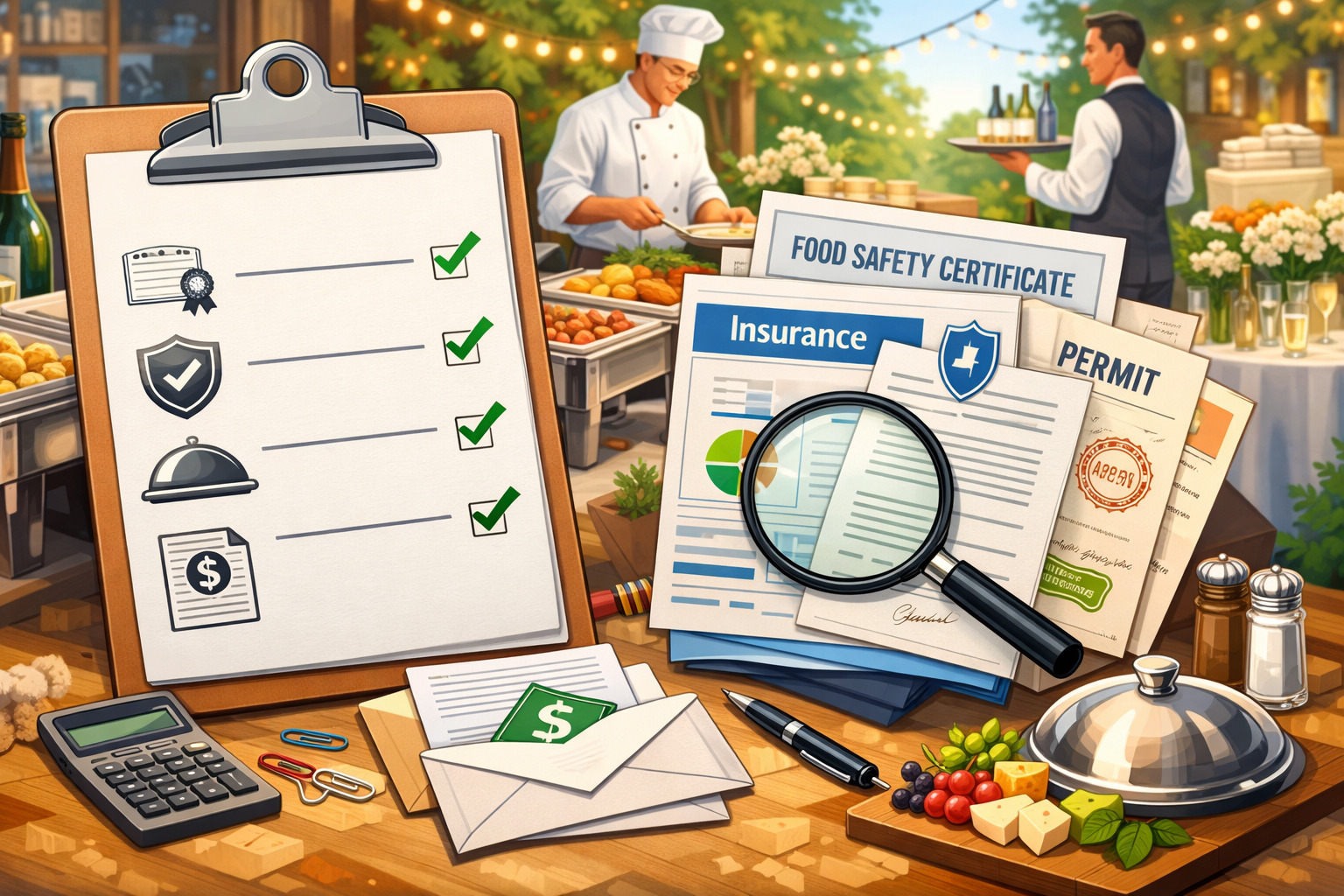
Paperwork isn’t glamorous, but it’s your safety net. This is where you protect yourself against venue rejection, liability gaps, and last-minute “we can’t do that” surprises. When planning Licensed caterers in Delaware events, collect these early—ideally before you pay a deposit.
Use this checklist to build your file:
- Business license documentation (or proof of business registration)
- Proof of permitted kitchen use
- Permit information for their facility, or
- Commissary kitchen agreement showing where food is produced
- General liability insurance certificate (confirm coverage limits)
- COI (certificate of insurance) naming your venue and/or you as additional insured (if required)
- Workers’ compensation proof (commonly required by venues)
- Auto liability coverage if they transport food/equipment (sometimes requested)
- Food safety certifications
- ServSafe manager certification (or equivalent), plus staff training policies
- Staffing credentials as relevant
- Captain/lead experience summary
- Bartender certification or responsible service training (if alcohol is served)
- Health department inspection details where applicable (ask what they can share)
- Rental partner information if they coordinate rentals (who delivers, who sets up, who is responsible for damages)
When you receive documents, match names carefully. The business name on the contract should align with the name on the insurance and the business license. Inconsistencies aren’t always malicious, but they are a cue to ask questions.
Checklist: Food Safety and Allergen Handling Standards to Confirm
Food safety is the most important “invisible” part of catering. When things go wrong, it can trigger guest illness, reputational damage, and serious venue issues. A licensed, professional caterer will have clear systems—especially for temperature control and allergens.
You’re not looking for perfect technical language. You’re looking for consistent, confident practices that show they take safety seriously.
Confirm these standards:
- Temperature logs are used for cooked items, cold items, and transport
- Clear procedures for hot holding (safe hot temperatures maintained) and cold holding (safe cold temperatures maintained)
- Use of adequate equipment: insulated carriers, hot boxes, refrigerated transport when needed, ice baths where appropriate
- A plan for time management (how long food is out during service)
- Safe cooling and reheating practices if anything is prepared ahead
- Dedicated protocols for allergen handling
- Separate prep areas when possible
- Clean tools and surfaces
- Labeling systems
- Staff training on cross-contact risks
- Ability to accommodate common dietary needs: gluten-free, dairy-free, vegan, nut-free, halal/kosher-style requests where feasible (with clear boundaries)
- Clear communication process: how dietary needs are collected, documented, and executed on event day
- Procedures for staff hygiene, glove use, and illness policies
A professional will also talk about what they won’t do if it compromises safety—like holding certain foods too long at an outdoor event in extreme heat.
Contract Essentials: What Your Catering Agreement Must Include
A catering contract isn’t just legal protection—it’s your blueprint for the entire experience. A good contract prevents misunderstandings and makes pricing honest. A vague contract is where surprise fees and scope disputes live.
When you’re Hiring a certified caterer in Delaware, look for a contract that is detailed but readable. You should be able to understand what you’re paying for, what’s included, and what triggers additional charges.
Here are the essentials to confirm:
- Event details: date, times, venue address, guest count minimum/maximum, service style
- Menu and service scope: exact menu items, substitutions, dietary accommodations process
- Staffing plan: number of staff, roles (captain/lead, servers, bartenders), staffing ratios
- Rentals and equipment: what the caterer provides vs what you must rent; setup responsibility
- Service charges: clear explanation of service charge vs gratuity (and whether gratuity is included)
- Overtime: how it’s calculated, when it applies, and rates per staff role
- Deposits and payment schedule: deposit amount, due dates, final payment deadline
- Guest count guarantee: deadline and how overages are handled
- Cancellation policy: refund structure, rescheduling terms, force majeure language
- Contingency planning: weather impacts, power constraints, venue restrictions
- Damage and loss: responsibility for rental damages, missing items, or property damage
- Leftovers policy: what happens to remaining food, packaging responsibility, safe handling guidance
If you see unclear language around service charges or “administrative fees,” ask for a line-by-line explanation. Transparent pricing builds trust.
Checklist: Tasting and Menu Evaluation (What to Assess Beyond Flavor)
Tastings are exciting, but they can also be misleading if you don’t evaluate the right things. A tasting portion prepared in calm conditions doesn’t always match what happens when a team is serving 150 plates under a tight timeline.
Your goal is to test quality and execution suitability. Bring a structured approach so you don’t get swept up in a great bite and overlook practical issues.
Use this tasting checklist:
- Flavor and seasoning balance (including whether it matches your crowd)
- Consistency across dishes (not just one standout item)
- Texture and holdability
- Does it dry out?
- Does it get soggy?
- Does it depend on immediate service?
- Portioning assumptions
- Ask what portion size is standard
- Confirm how they manage seconds at buffets
- Seasonal menus
- Are ingredients available reliably in your season?
- Will substitutions be needed?
- Dietary accommodations
- Taste at least one special-diet item if you have multiple needs
- Confirm allergen protocols and labeling plan
- Service style fit
- Some foods are great plated but messy at stations
- Some foods are risky outdoors in heat
- Presentation expectations
- Buffet décor and chafing dish setup
- Plating style for formal events
- Disposable vs china options for casual events
- Timing impact
- How long does it take to plate/serve this menu at your guest count?
- How do they sequence courses?
After the tasting, ask for a written recap of what was selected and what revisions were agreed upon. Memory fades. Documentation doesn’t.
Checklist: Event Execution Readiness (Load-In, Equipment, Temperature Control, Backup Plans)
A caterer can cook beautifully and still fail on execution. The most common breakdowns happen in logistics: load-in delays, missing equipment, inadequate power, and food not held safely. Execution readiness is what separates experienced professionals from well-meaning amateurs.
Before you sign—or at least before final payment—walk through the event-day plan.
Use this execution readiness checklist:
- Load-in plan
- Arrival time, route, parking plan
- Elevator access if needed
- Venue contact for day-of access
- Prep and staging plan
- Where they set up service stations
- Where they stage plates, glassware, and backups
- Where staff take breaks (if venue requires a specific area)
- Equipment list
- Hot boxes, chafers, induction burners, cambros
- Refrigeration plan (on-site refrigeration vs refrigerated transport)
- Water access needs
- Power plan
- Power requirements for warmers/induction
- Generator plan if outdoors or limited power
- Backup extension cords and safe cable management
- Temperature control
- How they maintain hot and cold temps during the full service window
- Who monitors and records temperature logs
- Service timeline
- When appetizers start
- When dinner is served
- When late-night snacks, desserts, coffee service happen
- Contingency plans
- Rain/wind adjustments for outdoor events
- Plan for delayed speeches or timeline shifts
- Backup staff options if someone calls out
- Cleanup scope
- Trash removal responsibilities
- Grease disposal plan
- End-of-night kitchen reset expectations
This is where experienced caterers shine. They’ll point out issues you didn’t anticipate and offer solutions early—when they’re easy to implement.
Working With Delaware Venues: Preferred Vendors, Kitchen Access, Fire Code, and Cleanup Rules
Delaware venues vary widely in what they provide and what they demand. Some have full commercial kitchens and clear vendor processes. Others offer minimal prep space, limited power, and strict rules about what can be brought in. Your catering success depends on aligning the caterer’s operations with the venue’s reality.
Start with the venue’s vendor requirements:
- Do they require venue-approved vendors only?
- Do they require minimum insurance limits or specific COI language?
- Do they have restrictions on open flame, grills, smokers, or fryers?
- What are load-in and load-out time windows?
- What are the cleanup requirements—and who is responsible?
- Do they require security, waste removal services, or specific bartending policies?
Kitchen access is a major variable. “Kitchen available” can mean anything from a full commercial line to a small room with a sink. Ask the venue:
- What equipment is actually available and usable?
- Is there refrigeration access? How much?
- Is there space to stage plated meals?
- Are there restrictions on using ovens or burners?
- What is the fire code policy for warming equipment or tented events?
A seasoned caterer will either do a walk-through or request photos and measurements. They’ll plan service around the venue’s constraints rather than hoping it works out.
Staffing and Service Quality: Captains, Ratios, Bartenders, and Professional Standards
Food is only half the guest experience. Service is what guests feel. It affects timing, comfort, cleanliness, and the overall tone of the event. Understaffing is one of the most common reasons events feel chaotic: long lines, empty water glasses, messy stations, late courses, and stressed staff who can’t recover.
A professional catering team typically includes an event captain or lead—the person who runs the floor, manages the timeline, and coordinates with the venue and other vendors. If you’re planning a wedding or a larger corporate event, that captain matters as much as the chef.
When discussing staffing, focus on:
- Who is the captain/lead and what’s their experience?
- How many servers will be on-site, and what are their roles?
- How will they manage resets, bussing, and trash?
- Who manages dietary meals and allergy-safe plates?
- What is the bartender plan if alcohol is served?
Staffing ratios vary depending on service style. Plated dinners require more hands and coordination than buffets. Stations can require specialized attendants. Cocktail receptions need staff for tray service and quick resets. The most reliable caterers explain why they recommend a certain staffing level and how it protects the guest experience.
Professional standards to look for:
- Clean uniforms and grooming standards
- Clear chain of command (captain leads)
- Calm communication style under pressure
- Proactive cleaning during service
- Respect for venue rules and property
Budgeting for Delaware Catering: What Drives Cost and How to Avoid Surprise Fees
Catering pricing can feel confusing because it’s not just “food per person.” You’re paying for labor, equipment, logistics, and risk management. The goal isn’t to find the cheapest quote—it’s to find the most transparent one, with scope that matches your expectations.
Key cost drivers include:
- Service style: plated service usually costs more than buffet
- Menu complexity: proteins, specialty ingredients, made-to-order stations
- Guest count and timing: larger counts and longer events raise labor needs
- Venue constraints: limited kitchen access increases off-site prep and equipment
- Rentals: china, glassware, flatware, linens, bars, tents, specialty furniture
- Staffing levels: servers, bartenders, chefs, dish crew
- Alcohol service rules: licensed bartenders, additional insurance, bar setups
- Travel and load-in complexity: long carries, stairs, tight load-in windows
Where clients get surprised is often in the “extras”:
- Service charge misunderstandings (service charge vs gratuity)
- Overtime due to timeline running late
- Additional rentals not included in the first quote
- Disposal fees, breakdown labor, or venue-required services
To stay in control, request a proposal that clearly separates:
- Food and beverage costs
- Labor and staffing
- Rentals and equipment
- Administrative/service charges
- Taxes (if applicable)
- Delivery/setup/breakdown costs
Common Mistakes to Avoid: Real-World Scenarios That Derail Events
Most catering disasters aren’t dramatic—they’re slow-motion problems that build until guests feel them. Below are issues I’ve seen repeatedly, and how to prevent them.
Mistake 1: Booking Before Confirming Venue Requirements
A couple falls in love with a caterer’s menu, pays a deposit, and then learns the venue requires a COI with specific limits—or only allows approved vendors. Suddenly you’re scrambling or paying a cancellation fee.
Prevention:
- Confirm venue vendor policies first.
- Share the venue’s requirements with the caterer before signing.
Mistake 2: Underestimating Staffing Needs
A buffet with 150 guests and only two servers leads to long lines, messy stations, and no one bussing tables. Guests feel neglected even if the food is good.
Prevention:
- Ask for staffing ratios and why they’re recommended.
- Make sure someone is assigned to cleanup and resets during service.
Mistake 3: Ignoring Outdoor Risk Factors
Outdoor events in warm months can compromise food safety and service comfort. Wind can blow over chafers. Heat can shorten safe holding times. Rain can destroy a timeline.
Prevention:
- Demand a weather contingency plan.
- Confirm equipment for hot holding/cold holding and shelter.
Mistake 4: Vague Contracts and Unclear Fees
A “simple” quote turns into extra charges for rentals, overtime, and staffing you assumed was included.
Prevention:
- Insist on detailed contracts and clear service charge explanations.
- Ask for a finalized event summary in writing.
Mistake 5: Not Confirming Insurance and Liability
A venue refuses entry on event day because the caterer can’t provide proper COI wording. It’s rare—but when it happens, it’s catastrophic.
Prevention:
- Request COI early and confirm venue acceptance.
- Verify coverage dates and listed insured parties.
A Practical Planning Timeline: 90/60/30/14/7 Days and Day-Of
Even if your event is smaller, a timeline keeps decisions from piling up at the end—when you’re most likely to miss important details.
90 Days Out: Build the Foundation
At around 90 days out, focus on locking in the right partner and defining your needs.
- Finalize guest count range and event format
- Confirm venue policies (vendor approvals, kitchen access, insurance)
- Shortlist caterers and request proposals
- Schedule tastings and review sample contracts
- Verify documents (business license, permitted kitchen, insurance, ServSafe)
This is also the right time to decide on major service style choices—plated vs buffet vs stations—because it affects staffing, rentals, and timing.
60 Days Out: Confirm Menu Direction and Logistics
Now you move from “who” to “how.”
- Confirm your menu direction and key dietary needs
- Identify rental needs (china, glassware, linens, bars, tents)
- Align on service timeline (cocktail hour, dinner, dessert)
- Confirm bar plan and alcohol service rules
- Schedule a site walk-through if needed
This is when you should also confirm staffing levels. If your caterer recommends more staff than you expected, ask what problems it prevents. Good staffing is often the difference between elegant and chaotic.
30 Days Out: Lock in Details and Documentation
In 30 days, tighten everything and reduce uncertainty.
- Confirm final menu selections and substitutions policy
- Confirm staffing counts and roles
- Confirm rentals and delivery timing
- Submit COI requirements to caterer and venue
- Confirm load-in plan and venue contact list
- Review contract for overtime triggers and service charge details
This is the point where you want fewer open questions. Final decisions now reduce last-minute “panic spending.”
14 Days Out: Final Adjustments and Guest Count Strategy
Two weeks out is your operational checkpoint.
- Confirm dietary list and how it will be executed
- Confirm table counts, floor plan, and buffet/station placement
- Confirm signage needs for allergens or stations
- Confirm timeline with your planner/venue and caterer together
- Confirm payment schedule and outstanding balances
If you’re hosting a fundraiser or community event with fluctuating attendance, plan for a realistic buffer and discuss how overages are handled.
7 Days Out: Final Confirmations
One week out is about ensuring nothing slips.
- Submit final guaranteed guest count by contract deadline
- Confirm arrival time, load-in, and parking permissions
- Confirm rental deliveries and who signs for them
- Confirm bar quantities if applicable
- Confirm day-of contact phone numbers and chain of command
This is also a good time to confirm what “cleanup” means. Some venues require trash removal off-site. Some require kitchen reset to a specific standard.
Day-Of: Execution and Communication
Your job on event day is to enjoy the event—not manage the kitchen. Set up a communication plan so you’re not the bottleneck.
- Introduce the caterer captain to your venue contact and planner
- Confirm the timeline and any last-minute changes
- Identify who approves timeline adjustments (planner vs you)
- Let the captain manage service flow
A well-run event feels effortless because the systems are working behind the scenes.
Post-Event Wrap-Up: Leftovers, Breakdown, Feedback, and Tipping
The event isn’t over when the last dessert plate is served. A professional wrap-up protects your venue relationship and helps you close the loop cleanly.
Leftovers and Food Safety
Ask your caterer ahead of time what their leftovers policy is. Some venues have rules about what can be left behind. From a safety standpoint, leftovers must be handled properly.
- Confirm whether leftovers will be packed and in what containers
- Confirm labeling for allergens and reheating guidance if they provide it
- Ask how they manage time/temperature safety for anything left
- Coordinate who takes leftovers home and where they’ll be stored
If food has been out for an extended period, a responsible caterer may limit what can be saved. That’s a sign of professionalism, not stinginess.
Breakdown and Venue Reset
Make sure the contract aligns with the venue’s expectations. Post-event issues often come from mismatched assumptions about cleanup.
- Who removes trash and where does it go?
- Who returns kitchen spaces to baseline condition?
- Who packs rentals and ensures counts are accurate?
- Who handles lost and found items like cake knives or serving utensils?
Feedback and Tipping
If service was excellent, let the company know specifically what stood out: captain leadership, calm problem-solving, attentive bartenders, or flawless timing. Specific feedback reinforces good teams.
Tipping policies vary. Some contracts include gratuity; some don’t. If tipping is optional and you want to do it, ask the captain for guidance on distribution so it reaches the staff appropriately.
FAQ
Q1) What should I ask first when comparing licensed caterers?
Answer: Start with the basics: where they prepare food (permitted kitchen or commissary kitchen), whether they can provide a COI (certificate of insurance), and whether they’ve worked at your venue before. These answers quickly reveal whether they’re operationally ready for your event.
Q2) Is a business license the same as being licensed to cater food?
Answer: Not necessarily. A business license typically confirms legal business operation, while food-related permissions often connect to the kitchen facility and how food is produced and served. Ask where food is prepared and what permitting applies to that facility.
Q3) How can I confirm a caterer’s kitchen is permitted?
Answer: Ask directly where the food is produced and request proof of permitted kitchen use. If they use a commissary kitchen, ask for the commissary agreement or documentation showing that arrangement.
Q4) What insurance should a caterer carry?
Answer: Most venues require general liability insurance and often workers’ compensation. Many venues also require a COI listing the venue as additional insured. Confirm your venue’s exact requirements and share them with your caterer early.
Q5) What is a COI, and why does my venue care?
Answer: A COI is a certificate of insurance that shows coverage and can list additional insured parties. Venues rely on it to reduce risk if there’s property damage, an injury, or an incident related to the caterer’s operations.
Q6) Do I need to worry about ServSafe?
Answer: You don’t need to memorize certification details, but you should confirm the caterer has trained staff and a clear food safety compliance system. ServSafe is a common credential that supports food safety knowledge, especially for managers.
Q7) How should a caterer handle allergens at a mixed-menu event?
Answer: They should have written or well-established allergen protocols: preventing cross-contact during prep, labeling meals, and a clear handoff process during service. If they sound uncertain, that’s a risk.
Q8) Can a caterer serve alcohol at my event?
Answer: Alcohol service rules vary by venue and event setup. Ask your venue what they allow and what they require (bartender certification, licensed bartenders, insurance wording, security). Then confirm the caterer can comply.
Q9) What staffing ratio is “right” for my event?
Answer: It depends on service style and venue logistics. Plated dinners typically require more staff than buffets. Cocktail receptions with heavy appetizers can also require more staff to keep food circulating and spaces clean. Ask the caterer to explain their staffing recommendation and what problems it prevents.
Q10) What’s the difference between a service charge and gratuity?
Answer: A service charge may cover operational costs and staffing overhead; gratuity is typically intended as a tip for staff. Each company handles this differently. Your contract should clearly define what is included and what is optional.
Q11) What are the biggest causes of surprise catering costs?
Answer: Common surprises include rentals not included in the initial quote, overtime when the timeline runs late, added staffing needs, and unclear service charges. Avoid surprises by insisting on detailed, line-item proposals and clear contract language.
Q12) How far in advance should I book a caterer?
Answer: For large weddings and peak-season dates, earlier is better. For smaller events, you may have more flexibility, but the most experienced teams still book up. Start your search as soon as you have your venue and date confirmed, especially if vendor approvals are required.
Conclusion
Hiring a caterer is one of the highest-impact decisions you’ll make for your event. The right team brings more than delicious food—they bring structure, staffing, safety systems, and the professionalism venues expect. The wrong choice can create last-minute venue conflicts, unsafe food handling, service breakdowns, and budget surprises.
If you’re planning Licensed caterers in Delaware events, your next steps are straightforward:
- Get your venue’s vendor requirements in writing.
- Request key documents early: business license, permitted kitchen/commissary proof, insurance and COI options, food safety credentials.
- Evaluate proposals for operational detail: staffing ratios, rentals, service charges, overtime, cleanup scope.
- Use tastings to test execution fit—not just flavor.
- Confirm the day-of logistics plan, including backup contingencies for outdoor or complex venues.
- Lock everything into a clear contract and a one-page event summary.
When you do this, you’re not just buying a meal—you’re buying peace of mind. And that’s what allows you, your guests, and your hosts to relax and actually enjoy the event.