
Category : Catering Resources

Catering Insurance Requirements in Delaware
March 3, 2026
Catering is one of those event services that touches almost everything: people, food, alcohol, rented spaces, timelines, vehicles, and a lot of moving parts.
In Delaware, that reality shows up fast when a venue asks for a certificate of insurance (COI), a client wants reassurance you’re “properly covered,” or a contract quietly shifts risk onto the caterer.
Insurance isn’t just a paperwork hurdle. It’s a practical risk-management tool that helps you keep working when something goes sideways—like a guest slipping near your buffet line, an allergen issue, a refrigeration breakdown, or a delivery accident on the way to a wedding.
It also signals professionalism. Many venues and planners treat proof of coverage as a baseline requirement before they’ll confirm a date, allow load-in, or approve alcohol service.
This guide walks you through Catering Insurance Requirements in Delaware in a clear, real-world way—what venues commonly require, why those requirements exist, what policies actually do (and don’t) cover, and how to get documentation right without stress.
You’ll also find practical checklists, claim scenarios, a planning timeline, and an FAQ you can share with your team or clients.
Why catering insurance matters for events in Delaware

When people hear “insurance requirements,” they often assume it’s just red tape. In the event world, it’s usually more specific than that: venues and clients are trying to prevent a single incident from turning into a multi-party dispute.
Catering operations introduce unique exposures because you’re bringing food, heat sources, equipment, staff, and sometimes alcohol into someone else’s property—often while guests move around in dress shoes and low lighting.
In Delaware, catering work ranges from beach-area receptions and historic properties to corporate events and private backyard celebrations. The risk patterns change with each setup.
A formal plated dinner creates different hazards than a food truck-style service, and a barn venue has very different property damage concerns than a hotel ballroom.
Insurance also protects relationships. When something happens, the question becomes: Who pays, who responds, and how fast can the event move forward?
Strong Delaware catering insurance requirements often exist because the venue has learned—sometimes the hard way—that clear coverage expectations reduce confusion after an incident.
Common reasons venues and clients care about coverage include:
- Guest injuries like slip-and-fall incidents in service areas
- Foodborne illness and allergy claims
- Property damage to floors, walls, kitchens, or outdoor spaces
- Alcohol-related incidents tied to service decisions
- Vehicle accidents during delivery or transport
- Claims involving temporary staff, subcontractors, or rented equipment
Good Delaware food catering business insurance isn’t about fear; it’s about continuity. It can keep your business operational while a claim is investigated, a defense is arranged, or damaged property is repaired.
What “requirements” really mean in Delaware
It’s important to clarify the word “requirements” in Catering Insurance Requirements in Delaware because it can come from more than one place. Most of the time, caterers encounter “requirements” from venues and contracts rather than a single universal rule.
The practical reality is that coverage expectations can vary by location, event type, guest count, alcohol service plan, and whether you’re using open flame or cooking onsite.
Here are the most common sources of insurance requirements:
- Venue policies: A venue may set minimum limits, require specific endorsements (like additional insured), and request a COI by a certain deadline.
- Client contracts: Your catering agreement might specify what you carry and how claims are handled. A client may also be bound by their venue contract, which flows requirements down to you.
- Vendor and subcontractor agreements: If you hire bartenders, rental companies, or staffing agencies, your contracts may require them to carry their own coverage and name you as additional insured.
- Event planners’ risk protocols: Planners often standardize checklists to avoid last-minute issues with venue approvals.
- Local rules and permits: Depending on the event setup, there may be permitting or operational rules that indirectly influence insurance needs (for example, alcohol service structure or where cooking is allowed). These are not uniform across every event, so verification matters.
Because insurance expectations can change, treat this guide as a practical framework—not a substitute for venue confirmation or professional advice. Always verify details with the venue, your insurance agent or broker, and any local authority involved in event permitting.
The core insurance types caterers commonly need in Delaware

Most Catering insurance coverage Delaware discussions come down to a core set of policies. The right mix depends on whether you operate from a commercial kitchen, cook onsite, serve alcohol, use vehicles for deliveries, hire staff, or work with subcontractors.
Below are the coverages that most often show up in Catering liability insurance Delaware conversations with venues, planners, and clients.
General liability insurance for caterers (including product liability and completed operations)
General liability is the foundation of most catering programs. It typically responds to claims that your business caused bodily injury or property damage to a third party.
In catering terms, that could mean a guest falls near your service station, a chafing dish tips and damages flooring, or your setup causes a venue’s fire alarm system to be triggered and results in cleanup costs.
For caterers, general liability commonly includes two concepts that matter a lot:
- Product liability: Claims arising from the food and beverages you serve (for example, a foodborne illness allegation).
- Completed operations: Claims that happen after your work is done but are still tied to your service (for example, a guest gets sick later and alleges it came from the event meal).
Venues often focus on general liability because it’s the policy most likely to respond to onsite incidents involving guests and property. They may request certain policy limits (more on limits below) and endorsements such as additional insured status.
General liability policies can also differ by how they handle certain exposures. For example, some policies have restrictions or exclusions around:
- Cooking with open flame or certain heating methods (“hot work”)
- Deep frying onsite
- Use of propane tanks
- Food trucks versus offsite-prepared drop catering
- Alcohol service (which may require separate liquor liability)
Catering liability insurance Delaware claim scenarios: slips, property damage, and food-related claims
When people search “Catering liability insurance Delaware,” they’re usually trying to understand what actually gets claimed in real life. In my experience advising caterers and planners, the most common claim categories fall into three buckets: guest injuries, property damage, and food-related allegations.
Typical examples include:
- A guest slips where staff moved through with drinks, ice, or sauces.
- Someone trips over a power cable that wasn’t sufficiently covered or taped down.
- A rented venue table is damaged by hot equipment or spilled liquids.
- Smoke from warming equipment triggers alarms and requires a venue response.
- A guest alleges food poisoning and seeks medical reimbursement.
- A guest with a known allergy has a reaction after cross-contact.
Your general liability policy is often the first line of defense, but the specifics matter. Exclusions, deductibles, and endorsements can change how a claim is handled.
It’s also common for multiple parties to be named in a lawsuit, even if the caterer didn’t “cause” the incident—because claimants may list everyone involved and let insurers sort out responsibility.
This is why venues want clear documentation and why your contracts should define responsibilities for guest flow, signage, and allergen communication.
Liquor liability: host liquor vs vendor liability and when you need it
Alcohol changes everything. Even when the food service is flawless, alcohol-related incidents can create high-severity claims—especially if someone leaves impaired and causes an injury or accident. That’s why liquor liability is one of the most misunderstood parts of Delaware catering insurance requirements.
Two terms come up a lot:
- Host liquor liability: Often applies when you are not in the business of selling/serving alcohol, but alcohol is present at an event you’re involved in. It may be included under some general liability policies, but it’s limited and not the same as full liquor liability.
- Vendor (or liquor) liability: Designed for businesses that serve or sell alcohol as part of their operations—such as bartending services, cash bars, or catering packages that include alcohol service.
Whether you “need” liquor liability depends on the event structure:
- If your staff is serving alcohol (even if the client purchased it), venues may require liquor liability.
- If you subcontract bartenders, the venue may require both the bartender’s liquor liability and yours, or it may require you to ensure the bartender names you and the venue as additional insured.
- If alcohol is served by the venue or a licensed bar service, the venue may rely on their own liquor liability, but they still might require proof of your general liability.
Also, venues often care about who is responsible for checking IDs, controlling service, and stopping service. Insurance is one layer; operational practices are another.
Workers’ compensation: staff, seasonal teams, and subcontractor considerations
Workers’ compensation is about protecting your employees (and your business) if someone gets hurt on the job. In catering, injuries can happen during load-in, kitchen prep, breakdown, or transport—think burns, cuts, lifting injuries, and slips in wet areas.
Even if a venue doesn’t ask for workers’ compensation on the COI, it can still be a contract requirement, and it often becomes important when you scale up staff for peak season. Planners may ask about it because they’ve seen staffing disputes after injuries.
Subcontractors complicate the picture. Many caterers use:
- Staffing agencies
- Independent servers or bartenders
- Specialty vendors (coffee carts, raw bars, carving stations)
The big question becomes: Are they truly independent and insured, or could they be treated like your employees for liability purposes? You’ll want a consistent process to collect proof of coverage and define responsibilities.
Commercial auto and hired & non-owned auto: deliveries and staff driving
If your business owns vehicles used for catering—vans, trucks, refrigerated vehicles—commercial auto coverage is essential. Personal auto policies often exclude or limit business use, and that’s a painful surprise after a crash.
Even if you don’t own vehicles, you still have exposure when:
- Staff use personal cars for deliveries, errands, or transporting equipment
- You rent vehicles for large events
- You reimburse mileage for business driving
This is where hired and non-owned auto coverage matters. It can help protect your business if you’re held liable for accidents involving vehicles you don’t own but are used for your operations.
For Delaware caterers, this often comes up when you deliver to venues with tight loading windows. A minor parking-lot accident can turn into a claim for property damage, injury, or both.
Property, inland marine, and equipment coverage (including rented equipment responsibility)
Catering relies heavily on gear: hot boxes, cambros, chafers, mobile bars, tents, glassware, linens, display pieces, and sometimes high-value cooking equipment. Standard property insurance may cover items at a specific location, but catering equipment is often on the move.
That’s why inland marine/equipment coverage is commonly used for mobile businesses. It’s designed to cover tools and equipment while transported or temporarily located at event sites.
You also need a plan for rented equipment responsibility. Rental contracts often make you responsible for:
- Loss or theft
- Breakage
- Damage during transport or setup
- “Mysterious disappearance” (which some policies treat differently)
If you regularly rent equipment, discuss equipment rental insurance options and how your policy treats rented property. Some policies can be endorsed to cover rented equipment, while others require separate arrangements.
Food spoilage and refrigeration breakdown coverage
Food spoilage is one of the most practical coverages for caterers—because it doesn’t require a guest to get sick for you to lose money. If refrigeration fails, a cooler breaks, or a power issue impacts storage, you may need to discard inventory immediately.
Spoilage coverage can help with the cost of lost food inventory due to specific causes like refrigeration breakdown, power failure, or mechanical issues. Some policies also address the cost to expedite replacement ingredients, though terms vary widely.
This coverage becomes more important when you:
- Store significant inventory
- Prep in advance for multiple events
- Use refrigerated transport
- Handle high-value proteins or specialty items
It’s also relevant when a venue provides refrigeration space and something fails. Responsibility can be unclear, and insurance can prevent a loss from turning into a dispute.
Umbrella/excess liability: when venues require higher limits
Many venues set minimum limits for general liability, and some require higher totals than a base policy provides. This is where an umbrella or excess liability policy comes in. It increases your available limits above underlying policies (like general liability and, sometimes, auto).
Umbrella requirements often show up for:
- Large guest counts
- High-profile venues
- Events with alcohol service
- Public spaces or municipal-style venues
- Corporate clients with standardized risk policies
Umbrella is also useful if you want a buffer for “worst-case” scenarios without buying extremely high limits on every underlying policy.
Optional coverages that can make a big difference in Delaware catering operations

Beyond the core policies, there are optional coverages that often come up once your business grows, you handle online payments, or you take on larger corporate events. These aren’t always part of baseline catering insurance coverage Delaware, but they can be smart additions depending on how you operate.
Cyber liability for online payments and client data
Many caterers take deposits online, store event details digitally, and manage invoices through web-based systems. That creates exposure if client data is compromised, payment links are spoofed, or an account is accessed improperly.
Cyber liability can help with costs related to:
- Data breach response and notification
- Forensic investigation
- Recovery after certain cyber incidents
- Liability claims tied to compromised data
- Business interruption from system outages (policy-dependent)
Even small catering companies can be targeted because invoices and deposit links are easy to impersonate. Cyber coverage isn’t a replacement for good security, but it can be a practical backstop.
Event cancellation and special event coverage add-ons
Caterers are often financially impacted when an event cancels late, but event cancellation coverage is usually purchased by the event host, not the caterer. Still, it can come up in client conversations, especially for high-budget weddings and corporate events.
Some caterers also provide or coordinate rentals, which can raise questions about what happens if:
- Weather disrupts an outdoor event
- Key participants are unable to attend
- A venue becomes unusable unexpectedly
Event cancellation coverage is highly specific, and terms vary. The best approach is to understand when it’s relevant and be prepared to recommend that clients discuss it with their own providers.
Employment practices liability insurance (EPLI) for staffing-related claims
As your team grows, employment-related claims become more relevant. EPLI can help with certain claims involving:
- Wrongful termination allegations
- Discrimination or harassment claims
- Retaliation allegations
- Some hiring and workplace-related disputes
Catering businesses often use seasonal staffing and fast-paced work environments. Clear policies and training help, but EPLI can provide support if a claim arises.
Realistic claim scenarios and how coverage may respond
Understanding coverage is easier when you picture how claims actually happen at events. Below are common scenarios tied to Catering liability insurance Delaware and how insurance may come into play.
Coverage depends on your policy language, endorsements, exclusions, and the specific facts of the incident, so treat these as practical examples—not guarantees.
Foodborne illness allegation after a wedding reception
A few guests report symptoms and suspect the chicken dish. The host contacts you the next day, and a guest asks for reimbursement for medical visits and missed work. Sometimes these situations escalate quickly, especially if multiple people complain online.
Potential insurance response often involves general liability with product liability and completed operations. Your insurer may:
- Investigate food handling steps and sourcing
- Review temperature logs and prep documentation
- Coordinate defense if a claim is filed
- Evaluate whether the allegation is tied to your food, another vendor, or guest handling
Operationally, your documentation matters a lot. Keeping records of timing, storage temperatures, and service procedures can help show you followed safe practices.
Allergen incident from cross-contact at a buffet station
A guest with a nut allergy has a reaction after eating from a dessert station. The family alleges cross-contact or mislabeling. Even if the ingredient list was accurate, buffet service can create cross-contact risk if utensils get swapped.
Insurance considerations may involve product liability under general liability. The claim may focus on whether your team communicated allergens clearly and took reasonable steps to prevent cross-contact.
Practical safeguards include:
- Clear labeling for common allergens
- Separate utensils and signage
- Staff trained to answer allergy questions accurately
- A “no guess” rule: if staff isn’t sure, they confirm with the chef
Slip-and-fall near the bar or service line
A guest slips where ice melted near the bar. Or someone trips over a cable near a carving station. These incidents are among the most common because events are busy, lighting is often dim, and guests aren’t watching the floor.
General liability is commonly implicated. Venues may also be pulled into the claim, which is why they often require additional insured status and primary and noncontributory wording—to push the claim toward the caterer’s policy first when the caterer’s operations are alleged to be involved.
Your defense often depends on:
- Setup diagrams and photos
- Incident reports and witness statements
- Proof of reasonable hazard control (mats, cord covers, signage)
- Staff training and quick response procedures
Property damage to a venue: floors, walls, or kitchen areas
A hot box scorches a hardwood floor. A sterno spill stains carpet. A wall is damaged during load-in. These can be expensive because venues may require specialized repairs or replacement.
General liability often applies when your operations cause property damage to a third party’s premises. However, some policies include limitations around damage to property in your care, custody, or control, so it’s worth reviewing how your policy treats venue property and rented spaces.
Also, rental and venue contracts may specify repair standards. A venue might demand immediate remediation, and insurance can help manage the cost and process.
Alcohol-related incident after service
A guest leaves the event impaired and is involved in an accident. Or there’s an on-premises incident tied to intoxication. These claims can involve multiple parties: the host, the venue, the bartender, and the caterer.
This is where liquor liability becomes critical if you served or sold alcohol. Host liquor versus vendor liquor distinctions matter. If you provided bartenders, controlled service, or ran a bar station, venues may expect vendor liquor coverage.
Insurers will evaluate:
- Who controlled service decisions
- Whether IDs were checked when needed
- Whether there was a plan to stop service to visibly intoxicated guests
- Whether the venue had its own alcohol program and controls
Delivery accident while transporting food and equipment
A team member rear-ends another vehicle while driving to the venue. Or a van damages a loading dock. Auto losses can create injury claims and property damage claims, and they sometimes trigger business liability allegations as well.
Commercial auto coverage applies for company vehicles. Hired and non-owned auto can be relevant when employees use personal vehicles for business tasks.
Auto incidents can also create event disruption costs, which may not be covered under liability policies. This is where operational planning—backup delivery windows, redundancy in equipment—helps you deliver even after a problem.
Certificates of Insurance (COIs): what they prove, what they don’t, and how to get them right
COIs are the heartbeat of venue compliance. Most Delaware venues won’t finalize approval without a COI that matches their requirements exactly. But COIs are also frequently misunderstood, especially by clients who assume a COI is the same thing as “full protection.”
What a COI is—and what it doesn’t prove
A certificate of insurance (COI) is a document issued by an insurer or agent that summarizes coverage in place at the time it’s issued. It typically lists:
- Named insured (your business name)
- Policy types and numbers
- Effective and expiration dates
- Limits of insurance
- Certificate holder (the venue or requesting party)
- Sometimes notes about additional insured or other requirements
What it doesn’t do is change coverage. A COI is not the policy itself. If the policy contains an exclusion, the COI doesn’t override it. If an endorsement is required, it must exist on the policy—not just be typed into a certificate notes section.
This is why venues sometimes require proof of endorsements in addition to the COI, especially for:
- Additional insured status
- Waiver of subrogation
- Primary and noncontributory wording
How to request a COI and what details must match the event and venue
The fastest way to avoid last-minute COI stress is to request it early and provide complete, correct information. COIs often get rejected for simple errors—misspellings, wrong venue name, wrong address, wrong date, or missing endorsements.
When requesting a COI, the key details to match include:
- Legal name of the venue or entity requesting the certificate
- Venue address (sometimes including specific building names)
- Event date(s) and times (especially for multi-day events)
- Description of operations (catering services, bartending, etc.)
- Required limits (general liability, liquor liability, umbrella, etc.)
- Specific endorsement language required (additional insured, waiver of subrogation, primary/noncontributory)
If your business name differs from your “doing business as” branding, make sure the named insured on the COI matches your legal insured entity. Mismatched names can cause a venue to deny acceptance.
Additional insured, waiver of subrogation, and primary/noncontributory: what venues commonly ask for
Venues in Delaware frequently request that they be named as additional insured on your general liability policy. This typically means the venue gains certain protections under your policy for claims arising out of your operations at their location.
Common additional insured-related requirements include:
- Additional insured wording tied to ongoing operations and sometimes completed operations
- Primary and noncontributory wording (your policy responds first for covered claims tied to your operations)
- Waiver of subrogation (your insurer waives certain recovery rights against the venue)
These requirements are usually handled through endorsements. A venue may accept a COI note, but many prefer endorsements to be on file or referenced properly.
Also understand the relationship between additional insured and responsibility. Being additional insured doesn’t automatically mean the venue is “at fault” or that your policy pays everything. It’s about how claims are defended and allocated when multiple parties are involved.
Checklists you can use for venues, COIs, and policy review
Checklists keep insurance from becoming a chaotic email thread. These are designed to be practical for Delaware caterers, planners, and clients reviewing Delaware catering insurance requirements.
Venue Insurance Requirement Checklist
Venues often ask for a consistent set of items. Use this checklist to confirm what’s required before you sign or finalize an event.
- Minimum general liability limits (per occurrence and aggregate)
- Confirmation that coverage includes product liability and completed operations
- Liquor liability requirement (if alcohol is served or bartenders are provided)
- Workers’ compensation requirement (especially for staffed service)
- Commercial auto requirement (if vehicles are involved)
- Umbrella/excess requirement (if higher limits are requested)
- Additional insured requirement (which entities must be named)
- Primary and noncontributory wording requirement
- Waiver of subrogation requirement
- COI submission deadline and recipient email
- Whether endorsements must be attached, not just noted on COI
- Any special restrictions (open flame, propane, deep frying, outdoor cooking)
COI Request Checklist: the exact information to provide your agent
When you ask for a COI, include everything your agent needs in one message. This reduces back-and-forth and speeds approval.
- Event name (as the venue expects it listed)
- Event date(s) and times (including setup and breakdown windows if needed)
- Venue legal name (exact spelling and punctuation)
- Venue address (including suite/building if applicable)
- Certificate holder name and address (if different from venue legal name)
- Email address where the COI must be sent
- Required policy types and limits (general, liquor, umbrella, etc.)
- Additional insured entities and exact wording requested
- Primary and noncontributory requirement details
- Waiver of subrogation requirement details
- Any contract language excerpts about insurance requirements
- Whether the venue requests endorsements attached
Policy Review Checklist for Caterers: limits, deductibles, exclusions, endorsements
At least once a year—ideally before peak season—review your policies like an operations tool, not just a renewal invoice.
- General liability limits (occurrence and aggregate)
- Product liability and completed operations included and appropriate for catering
- Liquor liability: host liquor vs vendor liquor clarified in writing
- Workers’ compensation in place for employees and structured for seasonal staffing
- Commercial auto coverage for owned vehicles (if applicable)
- Hired and non-owned auto coverage if staff drive personal vehicles
- Equipment/inland marine coverage limits match replacement cost reality
- Rented equipment treatment clarified (coverage or separate insurance)
- Spoilage/refrigeration breakdown coverage included if you store inventory
- Umbrella/excess limits meet common venue requirements you encounter
- Deductibles are financially realistic for your cash flow
- Contractual liability coverage aligned with your agreements
- Endorsements available for additional insured, waiver of subrogation, primary/noncontributory
- Any relevant exclusions reviewed (hot work, alcohol service, food service limitations)
Red Flags Checklist: what commonly causes COI rejection or claim headaches
These red flags show up constantly in venue reviews and can delay approval or create serious issues after an incident.
- COI shows an expired policy or a policy expiring before the event date
- Named insured doesn’t match your legal business name
- Venue name/address is incorrect or incomplete
- Missing additional insured endorsement (or only referenced vaguely)
- Primary and noncontributory requirement not addressed when requested
- Waiver of subrogation missing when required
- Limits are lower than the venue’s minimums
- Liquor liability missing when alcohol service is involved
- Exclusions that remove key coverage (food service, hot work, alcohol-related exclusions)
- Policy is claims-made without proper understanding (or without required tail arrangements)
- COI notes promise coverage not supported by the policy endorsements
How insurance ties into catering contracts: indemnification, liability caps, and subcontractors
Insurance and catering contracts work together. Insurance is your financial backstop, but your contract is what defines responsibilities, expectations, and how disputes are handled. Many caterers accidentally agree to contract language that expands their liability beyond what their policy is designed to cover.
Indemnification and contractual liability: aligning your contract with your coverage
Indemnification clauses determine who must defend and pay for claims tied to certain incidents. Some contracts ask a caterer to indemnify the venue or client for broad categories of claims, even those not caused by the caterer.
Insurance can cover some contractual liability, but it depends on policy terms and the contract language. If your contract obligates you to assume someone else’s negligence, that may create coverage issues—or at minimum, increase claim complexity.
Practical steps include:
- Avoid agreeing to indemnify another party for their sole negligence
- Keep indemnification tied to your operations and services
- Make sure the contract clearly defines who controls alcohol service decisions
- Specify client responsibilities for guest behavior, crowd control, and venue-provided conditions
Subcontractors, additional insured, and proof of coverage requirements
If you use subcontractors—bartenders, staffing teams, specialty food stations—you want their coverage to support your risk strategy. The best practice is to require:
- Proof of general liability (and liquor liability if applicable)
- A COI naming your business as additional insured when appropriate
- Clear scope of work and responsibility in writing
- An agreement that they will follow venue rules and safety protocols
Without this, a claim can become a messy triangle where everyone points elsewhere. Even if you’re not at fault, you may spend time and energy untangling responsibility while the client wants answers quickly.
Planning timeline: what to confirm at booking, 60/30/14/7 days out, and day-of
Insurance is easiest when you treat it like part of event production. Here’s a practical timeline that works for most Delaware catering operations.
At booking: lock down requirements and responsibilities early
As soon as the venue is selected and the scope is clear, confirm insurance expectations. This is when you want to identify whether the venue requires liquor liability, special endorsements, or higher limits.
At booking, aim to confirm:
- Venue insurance requirements document (written)
- Whether alcohol will be served and who controls service
- Whether onsite cooking/open flame is involved
- Load-in/load-out rules that affect safety setup
- Contract clauses related to indemnification and liability allocation
- Subcontractors needed and their insurance responsibilities
Getting these answers early prevents “COI panic” in the week of the event.
60 days out: review policies, confirm endorsements, and identify gaps
Two months out is a good window to review coverage needs without urgency. This is especially important for:
- Large guest counts
- Corporate events with strict protocols
- Venues that require endorsements attached
- Events involving bartending or cash bars
At 60 days, confirm:
- Your policies will be active through the event date
- You can provide required endorsements (additional insured, waiver of subrogation, primary/noncontributory)
- Any subcontractors have their insurance lined up
- Auto exposure is addressed if deliveries are complex
30 days out: request COIs and build the documentation pack
Thirty days out is the sweet spot for COIs: close enough that event details are stable, far enough that you can correct issues. This is when you should request COIs and confirm where they must be delivered.
At 30 days:
- Send COI requests with complete details (use the checklist above)
- Confirm venue acceptance process and who signs off
- Collect subcontractor COIs
- Store all documents in a single event folder with naming consistency
14 days out: verify acceptance and handle changes
Two weeks out is when last-minute changes can break insurance compliance—like adding alcohol service, adding cooking onsite, or changing venue spaces.
At 14 days:
- Confirm venue accepted the COI (don’t assume silence means yes)
- Re-check event scope: alcohol, equipment, cooking methods
- Confirm subcontractors and staffing changes
- Ensure any updated COIs are issued if details changed
7 days out and day-of: carry proof and keep it accessible
In the final week, your goal is simple: no surprises at load-in. Some venues ask to see the COI onsite, especially if there’s a venue manager change or last-minute staff rotation.
At 7 days and day-of:
- Carry digital and printed copies of COIs
- Ensure a manager knows where documents are stored
- Have a quick incident report template ready (just in case)
- Confirm any vendor insurance documentation required at check-in
Practical guidance for clients hiring caterers in Delaware: how to review insurance without being adversarial
Clients and planners often worry about sounding distrustful when asking for proof of insurance. The easiest way to keep it professional is to frame it as venue compliance and shared protection—because that’s what it is.
What clients should ask for and how to interpret it
Clients can request a COI and ask a few practical questions:
- Do you carry general liability that includes product/completed operations?
- If alcohol is served, who carries liquor liability—caterer, bartender, or venue?
- If staff are working, do you have workers’ compensation in place?
- If deliveries are involved, do you have commercial auto or hired/non-owned coverage?
Clients should understand that a COI shows coverage exists, but not every detail. It’s okay to ask for confirmation that required endorsements exist if the venue requires them.
If you’re the caterer, this is a trust-building moment. Provide the COI promptly, explain what it shows in plain language, and reassure the client that you can meet venue requirements.
FAQ
Q.1: What are the most common Delaware catering insurance requirements venues ask for?
Answer: Most venues start with general liability and a COI. They often request minimum limits for general liability and want confirmation that the policy includes product liability and completed operations, since food service claims can arise after the event.
Many venues also ask to be named as an additional insured and may require endorsements such as primary and noncontributory wording and a waiver of subrogation. If alcohol is involved, venues frequently require liquor liability, especially when the caterer or bartender controls service.
Requirements vary by venue type, event size, and service model, so it’s best to get the venue’s written insurance requirements early and share them directly with your agent.
Q.2: Do I need catering liability insurance in Delaware if I only do drop-off catering?
Answer: Drop-off catering can still create liability. Even if you don’t stay to serve, you may be responsible for food safety, packaging, labeling, and any equipment you leave behind (warming trays, fuel, or display items).
Claims like foodborne illness allegations or allergy incidents can arise after the event, which is where product liability and completed operations matter. Venues may still require a COI for any vendor delivering food to their property.
If you truly never enter venues and only deliver to private residences, requirements may be less formal—but the financial risk of a claim still exists. Many caterers find that maintaining general liability is a practical baseline even for drop-off operations.
Q.3: Is general liability enough for catering insurance coverage in Delaware?
Answer: General liability is foundational, but it’s not always enough. If you have employees, workers’ compensation is a key layer. If you own vehicles used for business, commercial auto is important, and if staff drive personal cars for deliveries, hired and non-owned auto can protect the business.
If you serve or sell alcohol, liquor liability may be required. If you rely on expensive mobile equipment or store valuable inventory, inland marine/equipment coverage and spoilage coverage can be very practical.
Many caterers start with general liability and then add coverage as their services expand, but it’s wise to review the full risk picture at least annually.
Q.4: What policy limits do Delaware venues usually require for caterers?
Answer: Limits vary, and there isn’t one universal standard. Many venues set a minimum general liability limit per occurrence and an aggregate limit for the policy period, and larger venues or corporate clients may require higher limits or an umbrella/excess policy.
Alcohol service can also trigger higher limit requirements. The best approach is to request the venue’s insurance requirement sheet and confirm the specific limits they expect for general liability, liquor liability (if applicable), and umbrella (if required).
If you work with multiple venues that regularly require higher limits, talk to your agent about whether an umbrella policy is a cost-effective way to meet those requirements consistently.
Q.5: What does “additional insured” mean for catering liability insurance Delaware situations?
Answer: When a venue is named as an additional insured, it generally means the venue gains certain protections under your policy for claims arising out of your operations at their location.
In real-world catering liability insurance Delaware situations, this often matters when a guest injury claim names multiple parties, including the venue and the caterer.
Additional insured status can help route defense and coverage appropriately under the caterer’s policy when the caterer’s work is alleged to be involved. It doesn’t automatically mean your policy pays for everything, and it doesn’t erase the venue’s own responsibilities. It’s primarily a risk-allocation tool that venues use to reduce coverage disputes.
Q.6: What is the difference between host liquor and vendor liquor liability?
Answer: Host liquor generally refers to limited coverage that may apply when alcohol is present but you are not “in the business” of selling or serving it as part of your operations. Vendor liquor liability is intended for businesses that serve or sell alcohol as a regular part of their services.
If your catering package includes bartending, you’re providing bartenders, or you control alcohol service decisions, venues often expect vendor liquor liability.
If the venue or a licensed bar service handles alcohol, the venue may rely on their own liquor liability, but they can still require your general liability. Because alcohol-related claims can be severe, clarify the service structure and make sure your policy matches your role.
Q.7: What should be on a certificate of insurance (COI) for a Delaware venue?
Answer: A COI should show your business as the named insured, the relevant policy types, effective and expiration dates, and coverage limits. It should list the venue (or the entity requesting proof) as the certificate holder, with the correct legal name and address.
If the venue requires additional insured status, primary and noncontributory wording, or waiver of subrogation, those requirements must be supported by endorsements—even if the COI includes notes about them.
COIs are often rejected for simple errors like wrong venue names, incorrect addresses, or event dates that don’t match the contract. Providing complete details to your agent and verifying acceptance with the venue prevents last-minute issues.
Q.8: Do I need workers’ compensation if I use freelance servers or a staffing agency?
Answer: It depends on your staffing structure and how those workers are classified, which is why you should discuss this with your insurance professional and payroll/staffing partners. From an operational standpoint, venues and planners often want assurance that staff injuries won’t become a dispute during the event.
If you use a staffing agency, the agency may carry workers’ compensation for their employees, and you should collect proof. If you use independent contractors, classification issues can create risk if a worker is injured and coverage isn’t clearly in place.
A practical approach is to require proof of coverage from staffing partners and maintain a consistent documentation process so there are no gaps.
Q.9: How does insurance interact with indemnification clauses in catering contracts?
Answer: Indemnification clauses determine who must defend and pay for claims tied to certain incidents. Insurance can cover some contractual liability, but not all contract language is treated equally.
If a contract requires you to indemnify another party for their sole negligence, that can create coverage challenges or at least increase claim complexity. Strong contracts typically tie indemnification to your own operations and services and clearly define responsibilities for alcohol service, guest control, and venue-provided conditions.
Before signing major venue or corporate agreements, it’s smart to have your agent review insurance-related sections so your coverage aligns with your obligations and you can add endorsements where appropriate.
Q.10: What are the biggest red flags when reviewing a caterer’s insurance?
Answer: The biggest red flags are administrative issues that make the COI unreliable or noncompliant, and coverage gaps that conflict with the event’s risk profile.
Watch for an expired policy, a COI that expires before the event date, mismatched business names, missing additional insured endorsements when required, missing primary and noncontributory wording, and missing waiver of subrogation language when requested.
Also be cautious if alcohol is served but liquor liability is not addressed, or if the policy has exclusions that remove key exposures like food service, hot work, or alcohol-related operations. A professional caterer should be able to explain their coverage clearly and provide updated documentation quickly.
Conclusion
Meeting Catering Insurance Requirements in Delaware is less about chasing paperwork and more about building a repeatable process. Venues want to see that your business can handle real-world incidents—guest injuries, food-related claims, property damage, alcohol exposures, and vehicle risks—without turning every problem into a dispute.
The best caterers treat insurance as part of operations. They align coverage with services, keep contracts clean, manage subcontractor documentation, and handle COIs early—so event week is about execution, not scrambling.

Delaware Catering Contracts Explained (Requirements & Terms)
March 3, 2026
Planning an event is exciting—until something goes sideways. A missing entrée, a surprise “labor” fee, a bar plan that isn’t allowed at the venue, or a cancellation clause that doesn’t match your expectations can turn a great day into a stressful one.
That’s why a solid catering contract matters. It’s not just paperwork. It’s the roadmap that protects your budget, your timeline, your guests, and your relationship with the caterer.
In my experience reviewing catering agreements across Delaware venues—from historic properties to beach-area sites to corporate spaces—the biggest problems usually come from vague: “standard staffing,” “typical rentals,” “subject to change,” or “final guest count due soon.”
Those phrases feel harmless when you’re busy, but they’re where disputes start. Your goal isn’t to “win” a contract negotiation. It’s to remove ambiguity so both sides know exactly what’s included, when decisions are due, and what happens if circumstances change.
This guide breaks down Delaware catering contract requirements and terms. You’ll learn what a contract should include, what to question, what to negotiate, and how to confirm details as your event date approaches.
It’s written for non-lawyers who want practical, confident decision-making—whether you’re planning a wedding, corporate event, nonprofit fundraiser, private party, or community gathering.
Quote vs Proposal vs Invoice vs Contract (And What’s Binding)

One of the most common misunderstandings I see is assuming a quote equals a contract. It doesn’t—at least not reliably. A quote is often a snapshot of pricing based on assumptions (guest count, menu selections, staffing, rentals, service style, venue access). It’s a starting point for budgeting, not a final promise.
A proposal is usually more detailed: it might list menu items, service style, staffing suggestions, rental needs, and timelines. Proposals are helpful, but many are still “subject to change” until the agreement is signed and deposits are paid.
An invoice is typically a billing document—sometimes used for deposits and installments. Invoices can reflect what you owe, but they don’t always include the full scope, responsibilities, or legal terms.
A binding Delaware event catering agreement is the document that clearly states what both parties are committing to—and under what conditions. It should identify the parties, define the scope of services, list the fees and payment schedule, establish deadlines (like the guest count guarantee), and spell out cancellation, refunds, and rescheduling rules.
This distinction matters because disputes often arise when the caterer thinks they’re following the contract, while the client thinks they’re following the proposal or “what we discussed.” Your contract should either include the proposal as an attached exhibit or explicitly state which documents are incorporated.
What to Look For in the “Contract Documents” Clause
Many agreements include a clause that defines what counts as the final deal: the signed contract, plus any exhibits, addenda, and approved menus.
If that clause is missing or vague, you risk a “he said, she said” situation later. You want the contract to state that any changes must be written and signed (or at least confirmed via a defined approval method, like email confirmation from both parties).
Look for that clarifies whether the proposal is binding, whether the invoice is merely billing, and whether verbal promises are excluded.
Some contracts include an “entire agreement” section that says only the contract counts. That can be fine—if the contract is complete. If it’s not, you need your details inside the contract, not in someone’s memory.
If you negotiated something important—extra bartenders, a specific brand of linen, a waived cake-cutting fee—make sure it’s included in the contract or an addendum. A handshake is friendly; a written term is enforceable.
When a “Simple Agreement” Isn’t Enough
Smaller gatherings sometimes use a short-form contract. That can work, but only if it covers the major risk areas: guest count, menu, staffing, rentals, payment timing, cancellations, venue logistics, and liability.
For weddings and larger corporate or nonprofit events, you’ll almost always benefit from a more complete agreement because there are more moving parts.
If you’re coordinating multiple vendors—venue, rental company, bar service, planner, entertainment—small omissions become big headaches. Who is responsible for trash removal? Who handles load-in timing? Who brings power cords for buffet warmers? A short agreement may not address these, leaving you to solve problems on event day.
Legal Requirements for Catering Contracts in Delaware (What You Should Verify)

When people search for “Legal requirements for catering contracts in Delaware,” they’re often hoping for a simple checklist of statutes.
In reality, catering rules can intersect with multiple layers: venue policies, local health and safety expectations, alcohol service requirements, and business practices that may vary by city, county, and event type.
Because details can change and vary, treat this section as a practical “verify and document” guide—not a substitute for professional legal guidance.
At minimum, you want your contract to be clear, truthful, and consistent with what is actually allowed at your venue. Many venues in Delaware have strict rules that effectively function like “requirements” for your agreement—such as requiring insured vendors, restricting open flames, limiting kitchen access, or requiring a certificate of insurance (COI) naming the venue as additional insured.
Your caterer may also need to follow food safety procedures that are influenced by where food is prepared, transported, and held before service.
If alcohol is involved, confirm who is legally and contractually responsible for bar service, ID checks, and compliance with venue rules. Venues often require licensed bartenders or specific security procedures. Even if your event is private, contracts should align with the venue’s policies and any applicable local requirements.
Finally, remember that your contract is also a planning tool. The more specific it is about responsibilities (permits, licensing, insurance, staffing, rentals, sanitation, cleanup), the fewer “surprises” you’ll face.
The Safe Way to Handle Compliance
A trustworthy caterer won’t guess about compliance—and neither should you. Instead of demanding citations or legal, ask for practical confirmations:
- “Are you able to cater at this venue under their current rules?”
- “Do you carry liability insurance, and can you provide a COI?”
- “If the venue requires additional insured status, can you list them?”
- “How do you handle transport and hot/cold holding for offsite events?”
- “If a permit or inspection is needed for this venue type, who handles it?”
Your contract can include a clause that each party will comply with applicable rules and venue policies, and that the client will disclose any venue restrictions in advance. That’s helpful without becoming overly legalistic.
Local Authorities and Venue Policies Can Change the Terms
Delaware events can range from a backyard tent to a downtown ballroom to a community center. Each setting can change what’s required: kitchen access, handwashing stations, trash handling, power, water, and even noise ordinances can affect timing and staffing. Some venues require union labor or approved vendor lists. Some require fire marshal clearance for certain equipment.
Your contract should include a “venue logistics” section and a “client responsibilities” section that accounts for your exact venue. If your contract is generic, treat that as a cue to add venue-specific details through an addendum.
Core Sections in Catering Contracts in Delaware

Every strong catering agreement covers the same foundation—who, what, when, where, and how much—plus what happens when plans change. When you’re reviewing Delaware catering contract requirements, focus on whether each section answers the real-world questions you’ll have as the event gets closer.
Start with the parties and event details, then move into the scope of services. “Scope” is where most misunderstandings live. It should describe the service style (plated, buffet, stations, family-style, cocktail reception), staffing and timing, rentals, setup/breakdown, and cleanup.
If something is important to you—like passing hors d’oeuvres for the first hour or coffee service through dessert—it should be stated clearly.
Next, look at pricing structure and guest count rules. This includes minimum spend, per-person pricing vs package pricing, guaranteed count deadlines, and overage/shortage policies. Then review payment timing, deposits, accepted payment methods, and late fees.
Finally, check the protections: insurance, liability, indemnification, damage responsibility, cancellation/refund policy, rescheduling rules, force majeure, and dispute resolution. These sections feel “worst case,” but they’re the reason contracts exist.
Parties, Event Details, and Point of Contact
This section should name the legal business entity of the caterer (not just a brand name), plus the client name(s) responsible for payment. It should include the date, venue address, start/end times, and the service window (when food is served). Service window matters because overtime often depends on it.
Also confirm the point of contact: Who can approve changes? Who will be onsite day-of? If you have a planner, do they have authority to adjust timing or add items? It’s common to limit who can sign off on extra charges.
Look for a clause that says changes must be approved by a specific person (and ideally in writing). That protects you from a well-meaning relative “adding espresso service” at the last minute.
Scope of Services: Setup, Breakdown, Staffing, and Rentals
Scope is the heart of Delaware catering contract terms. It should answer:
- What the caterer is providing (food, service, bartending, rentals, linens, disposables)
- What the client must provide (tables/chairs, power, water, tenting, permits, trash access)
- What the venue provides (kitchen, ice machine, storage, loading dock)
It should also list setup and breakdown responsibilities: Who sets tables? Who places centerpieces? Who clears plates? Who takes trash to the dumpster?
If rentals are included, the contract should specify what items, quantities, and quality level (standard vs upgraded). If rentals are not included, the contract should specify what you need to rent separately and who coordinates delivery and pickup.
Menu and Service Style (And How Changes Are Handled)
Your contract should include the actual menu or attach it as an exhibit. “Chicken or fish” isn’t enough. You want preparation style, key ingredients, and what sides come with each entrée—especially if you’re comparing proposals.
The service style should be specific. “Buffet” can mean self-serve or staffed. “Plated” can include or exclude courses and table resets. Stations can require extra chefs and power.
Also check the menu substitution policy. Seasonal availability and vendor supply issues happen. The contract should explain how substitutions are handled, how much notice you’ll receive, and whether substitutions must be “equal or better” in value.
Guest Count, Minimum Spend, and Pricing Models
Guest count rules are one of the most important Delaware catering contract requirements and terms because they directly control your total price and your ability to make adjustments.
Caterers plan staffing, food ordering, rentals, and prep schedules based on expected attendance. That’s why contracts often include a minimum guest count, a minimum spend, or both.
Per-person pricing is straightforward: you pay a price per guest for a defined menu and service. Package pricing can be helpful too, but it must state what’s included. Packages sometimes exclude rentals, staffing upgrades, late-night snacks, or bar services—so you’ll want itemized clarity.
Look for a “guaranteed count” clause. This is the number you commit to pay for, even if fewer guests show up. The contract should state the deadline for submitting the guarantee (often 7–14 days before the event), how it must be delivered, and whether you can increase the count after that deadline (and if so, how late you can do it).
Also watch for “minimum spend”. Minimum spend can apply to food and beverage only, or to the full invoice. The contract should define it clearly so you don’t assume rentals count toward it when they don’t.
Guaranteed Count Deadlines and Overage Policies
A strong contract spells out: “Guaranteed count due X days prior by Y method.” It should also say what happens if your final guest count is higher than expected. Many caterers will accommodate a limited overage (for example, up to 5%) if you notify them by a certain date, but they may charge premium rates for last-minute increases.
Ask how overages are calculated. Is it per-person pricing? Is there an overtime or staffing add-on? Are extra rentals needed? If you expect late RSVPs, you want a clear plan.
Also clarify whether children are priced differently, whether vendor meals are required (photographers, DJs), and whether those count toward the guarantee.
Per-Person vs Package Pricing (How to Compare Apples to Apples)
When comparing quotes, confirm the “included items.” One caterer’s per-person price may include staffing and rentals; another’s may not. Packages may look cheaper until you add service charge, rentals, and bar equipment.
Ask the caterer to provide a “total cost estimate” including common add-ons: staffing, rentals, service charge, taxes, administrative fees, and travel fees. You want clarity now, not on the final invoice.
Deposits, Payment Schedule, and Late Fees
Payment terms are where friendly conversations turn uncomfortable—usually because expectations weren’t set early. Your contract should state the deposit amount, when it’s due, whether it’s refundable, and how it’s applied (toward the final invoice or held separately).
Many catering contracts in Delaware use installment schedules: a deposit at signing, a second payment, a set number of days out, and the final payment shortly before the event. The contract should list exact due dates (or a formula tied to the event date), accepted payment methods, and any processing fees for card payments.
Check the late fee. Late fees should be clearly defined, not open-ended. Also check whether late payments can trigger cancellation by the caterer. That can be a serious risk if a payment is missed due to a bank issue.
Also confirm how changes affect billing. If you add rentals or upgrade the menu, when is the additional amount due? Is it folded into the next installment or due immediately?
Deposits: What They Reserve and What They Don’t
A deposit typically reserves the date and secures staffing. But don’t assume it locks in pricing, menu availability, or rental inventory unless the contract says so. Ask whether pricing is guaranteed or subject to adjustments (for example, if food costs change). If adjustments are possible, ask for limits or advance notice requirements.
Also confirm what happens if the event date changes. Is the deposit transferable? Is there a rescheduling fee? Are there blackout dates or seasonal constraints?
Accepted Payment Methods and Processing Fees
The contract should list accepted methods (check, bank transfer, card) and whether there are any convenience fees. You don’t want to discover a percentage-based card fee on a large final payment.
Also clarify who receives the invoice and who is authorized to pay. For corporate or nonprofit events, confirm whether purchase orders are required and how tax-exempt status is handled if applicable.
Service Charge vs Gratuity, Taxes, and Administrative Fees
This is the section that produces the most “I didn’t realize that” reactions. Contracts often include service charges, administrative fees, and taxes—but those terms aren’t always explained clearly. Your goal is total transparency so you know what you’re paying for and how much goes to staff.
A service charge is typically an added percentage that helps cover labor and operating costs. It may or may not be distributed to staff. A gratuity is a tip intended for the service team.
Contracts should define both clearly. If the contract includes a service charge, ask whether it’s in place of gratuity, whether gratuity is optional, and whether any portion is paid directly to staff.
Also confirm what’s taxable. Food and beverage may be taxed, and service charges sometimes are as well depending on structure. Rather than guessing, ask for a complete estimate showing all fees and taxes in one place.
Administrative fees can cover planning, coordination, or overhead. They’re not inherently wrong, but they should be disclosed and defined. “Admin fee: 10%” without explanation is a red flag.
Fee & Charge Transparency Checklist
Use this checklist to confirm you understand every dollar:
- Is there a service charge? If yes, what percentage and what does it cover?
- Is gratuity included, optional, or not allowed by the contract?
- Are taxes applied to food only, or to service charges and rentals too?
- Are administrative fees separate from service charges?
- Are labor charges itemized (chefs, servers, bartenders)?
- Are rental delivery, setup, and pickup charges included?
- Are travel fees, fuel surcharges, or parking fees possible?
- Are overtime rates stated clearly?
- Are “miscellaneous” or “coordination” fees defined?
Staffing Ratios and Labor Minimums
Contracts sometimes include minimum labor hours or staffing minimums, especially for smaller events. That can be reasonable—staffing a 40-person plated dinner may still require a chef, servers, and setup crew. But you should understand the assumptions and the rate structure.
Ask how staffing changes if your timeline changes. If your reception runs longer, do you pay overtime per staff member per hour? Is there a minimum overtime block (for example, billed in full-hour increments)? Are breaks required for staff in longer events?
Overage/Shortage, Substitutions, and Supply Issues
Even with perfect planning, real life happens. A delivery arrives short, a vendor substitutes an ingredient, or a key menu item becomes unavailable. Your contract should acknowledge these realities and define the process for handling them fairly.
Start with overage/shortage policies. If you provide a guaranteed count of 150 and 160 guests show up, what happens? Some caterers can accommodate a limited overage at the same per-person rate if given notice, while others require pre-approval due to staffing and inventory.
If the contract says the caterer is not obligated to serve overages, that’s important to know—especially for community events or open-invite fundraisers.
Next, review substitution. Seasonal menus are wonderful, but substitution clauses should not be a blank check. Ideally, the contract states that substitutions will be comparable in quality and value, and that the client will be notified as early as possible.
Supply issues can also impact rentals: linens out of stock, glassware shortages, or last-minute equipment replacements. The contract should clarify whether alternative items may be provided and whether pricing changes.
Menu Substitutions: How to Make It Fair
You can ask for a substitution process that’s realistic and respectful:
- The caterer notifies clients promptly when a key item is at risk.
- Caterer proposes an equal-quality alternative.
- Client approval is required for major substitutions (main proteins, featured appetizers, special dietary meals).
- Price remains the same unless the substitute is a confirmed upgrade or downgrade.
This keeps flexibility without giving up control.
Handling Vendor Shortages Without Surprise Charges
Some contracts allow pricing adjustments if costs rise. If that exists, ask for boundaries: advance notice, caps, or adjustments limited to specific categories. A common compromise is: “pricing is locked after final menu confirmation,” or “adjustments require client approval.”
Also confirm rental responsibility if items are missing or broken. If rentals are delivered short, who resolves it—the caterer or the rental company? If rentals are returned broken, who pays?
Dietary Restrictions, Allergens, and Special Meals
Dietary needs are no longer an edge case—they’re normal. Your catering contract should explain how the caterer handles dietary restrictions, allergens, labeling, and special meals. This protects your guests and reduces your liability risk.
Start by confirming how dietary information is collected. Some clients provide a list; some use RSVP forms; some rely on day-of requests. Day-of is the riskiest method. Your contract should include a deadline for submitting dietary requests and a process for confirming them.
Next, look for allergen. Many caterers will explain they cannot guarantee an allergen-free environment, especially in shared kitchens. That can be reasonable. But you still want clear steps: ingredient disclosures, labeling, separate plating, and cross-contact precautions when feasible.
Special meals (vegan, gluten-sensitive, dairy-free, nut-free) should be listed as a count and type, not just “we’ll accommodate.” If a guest’s needs are severe, you may need to coordinate directly with the caterer and the venue.
Labeling and Cross-Contact Precautions
For buffets and stations, labeling is critical. Your contract can include requirements like:
- Labels for major allergens on buffet items (or a printed ingredient list available onsite)
- A plan to keep allergen-sensitive items separate
- Dedicated utensils for specific dishes
- Staff guidance to answer guest questions accurately
Cross-contact can happen through shared utensils, cutting boards, fryers, or service surfaces. The contract should not promise perfection, but it should define best practices and communication.
Special Meals: Plated vs Buffet Realities
Plated service makes special meals easier to control. Buffet service requires more planning. If you’re doing a buffet and have multiple special meals, consider adding a “special meal station” or having special meals plated and delivered by staff.
Also clarify whether special meals cost extra and whether they count toward the guaranteed guest count.
Food Safety Responsibilities: Transport, Holding, and Leftovers
Food safety is a shared responsibility, especially for offsite events. Your contract should clearly state who is responsible for safe transport, hot/cold holding, and how long food can remain out during service.
If the caterer is preparing food offsite and transporting it, ask about temperature control: insulated carriers, hot boxes, refrigeration, and timing. If your venue provides kitchen space, confirm what equipment is available and what the caterer is allowed to use.
Leftovers are another overlooked area. Some venues prohibit clients from taking leftovers; some caterers will not release leftovers due to safety protocols; some will package leftovers if requested. Your contract should state whether leftovers will be packaged, who provides containers, and when leftovers must be retrieved.
Also address water, handwashing, and sanitation needs—especially for outdoor events, pop-up community gatherings, or tented receptions.
What the Contract Should Say About Leftovers
A practical contract clause covers:
- Whether leftovers may be taken by the client
- Whether the caterer will package them (and at what cost, if any)
- The timeframe for claiming leftovers after service
- Any venue rules affecting food removal
This prevents awkward, day-of confusion when guests are asking for takeaway and the staff is following policy.
Outdoor Events and Power/Water Requirements
Outdoor catering often requires additional equipment: generators, handwashing stations, lighting, and extra staff time for load-in. Your contract should specify whether the caterer provides these or whether you must rent them.
Also confirm what happens if the venue has limited power. Some warming equipment draws significant power, and tripping breakers during dinner service is a bad time.
Alcohol and Bar Service Terms (Outside Alcohol Rules Included)
Bar service can be simple—or it can become the most complex part of your contract. Start by confirming who provides alcohol: the client, the caterer, a bar vendor, or the venue. Then confirm who provides bartenders, bar equipment, ice, mixers, garnishes, cups/glassware, and trash handling for bottles and cans.
Contracts should also address ID checks and service policies. Even at private events, responsible service matters. Venues may require wristbands, security, or specific rules about last call.
Outside alcohol rules are especially important. Many venues have policies that limit outside alcohol, require approved bartenders, or restrict self-serve stations. Your catering contract must match the venue rules or you risk last-minute cancellations of bar plans.
Host Bar, Cash Bar, and Consumption Models
If your event is corporate or nonprofit, you may choose:
- Host bar (you cover the cost)
- Cash bar (guests pay)
- Ticket bar (limited tickets per guest)
- Consumption bar (you pay for what’s poured)
Your contract should define the model and how it’s tracked. For consumption bars, ask how pours are measured and what documentation you receive after the event.
Bartender Counts, Overtime, and Last Call
Bar lines can ruin guest experience. Contracts should clarify bartender staffing ratios and whether additional bartenders can be added. Also confirm last call timing and whether bar service ends earlier than the event end time (a common venue rule).
Overtime should be clear: if your timeline runs late, do bartenders charge overtime per hour? Is there a minimum overtime charge?
Insurance, Liability, COI, Additional Insured, and Damage Responsibility
Insurance and liability terms can feel intimidating, but they’re essential. Most Delaware venues require caterers to carry liability insurance and provide a COI (certificate of insurance).
Your contract should state whether the caterer can provide a COI, whether the venue must be named as additional insured, and whether there’s a fee for issuing certificates.
Look for responsibility: if the catering staff damages the venue, who pays? If guests damage rental items, who pays? If the client provides décor that damages tables, who pays? Ideally, responsibility is assigned based on control: the party who caused the damage or had direct responsibility for the item.
Also pay attention to indemnification. In plain terms, indemnification is about who covers certain losses or claims. You don’t need to become a legal expert, but you should understand whether the contract is balanced and whether it asks you to accept responsibility for things outside your control.
Damage Waivers and Rental Responsibility
If rentals are included, your contract should specify who is responsible for damage or loss. Some caterers include a damage waiver option. If so, ask what it covers and what it excludes (for example, theft, intentional damage, candle wax, or weather-related damage).
For outdoor events, weather risk is real. If linens, chairs, or dinnerware are exposed to rain and get damaged, who pays? Your contract should address tenting expectations and contingency plans.
What to Ask About Coverage and Limits
You can ask simple questions without getting technical:
- “Do you carry liability insurance for offsite catering?”
- “Can you provide a COI for my venue?”
- “If the venue requires additional insurance, can you list them?”
- “Who is responsible for damages to venue property and rentals?”
- “Do you require the client to carry event insurance?”
Cancellation, Refunds, Rescheduling, and Force Majeure (Weather Plans)
If you want to avoid heartbreak and budget shock, read the cancellation section slowly. This is one of the most important Delaware catering contract terms, especially for events booked far in advance.
A fair cancellation policy usually ties refunds to timing. The closer you are to the event date, the more costs the caterer has already incurred (staffing commitments, food orders, prep time). Your contract should specify what portion of payments is refundable at each stage and what portion is non-refundable.
Rescheduling and postponement rules should be separate from cancellation. If you move the date, does the deposit transfer? Is there a rescheduling fee? Is pricing guaranteed on the new date? Are there limits on how far out you can move?
Force majeure clauses address major disruptions (severe weather, emergencies, events beyond reasonable control). Because specifics can vary, focus on what the clause actually does: Does it allow either party to cancel without penalties? Does it require rescheduling? Does it address partial performance if the event is shortened?
Cancellation and Refund Policy: What “Non-Refundable” Really Means
Non-refundable deposits are common, but the contract should still define what the deposit covers. Also confirm whether payments beyond the deposit become non-refundable as you approach the event date.
If the contract allows the caterer to keep all payments even if cancellation happens months out, that’s worth negotiating. A more balanced approach is a sliding scale tied to timing and documented costs.
Rescheduling Terms: Transfers, Credits, and Price Changes
If you might reschedule (seasonal events, nonprofit fundraisers, corporate calendars), negotiate:
- Deposit transfer rules
- Deadline to request rescheduling
- Whether pricing changes on the new date
- Whether menu changes are allowed
- Whether the caterer can refuse certain dates
Venue Logistics: Load-In/Load-Out, Kitchen Access, Power/Water, Trash Removal
Venue logistics are where great catering plans either run smoothly or fall apart. Your contract should include details about load-in and load-out windows, access points, and restrictions. Many venues have strict timing for deliveries and require staff to park in certain areas or use specific entrances.
Kitchen access is another big one. Does the caterer have access to a prep kitchen, warming kitchen, or only a staging area? If there’s limited kitchen access, the caterer may need extra equipment and staff time, which should be reflected in pricing.
Power and water requirements should be clear, especially for stations, outdoor events, or venues with limited outlets. If the caterer needs dedicated circuits for warmers or coffee service, confirm it early.
Trash removal and cleanup responsibilities must be written. Does the caterer remove trash from the dumpster? Does the venue require trash sorting? Are there extra fees for hauling? Who cleans the kitchen space?
Setup/Breakdown Timing and Overtime Rates
Your event “ends” when guests leave, but catering work continues. Breakdown, packing, cleaning, and load-out can take hours. Contracts should clarify whether staffing is billed based on guest-facing service time or total onsite time.
If overtime is possible, the contract should list rates and billing increments. You should also confirm who can approve overtime on event day (client, planner, venue coordinator).
Cleanup, Trash, and Damage Prevention
Cleanup expectations should include:
- Clearing tables and disposing of food waste
- Trash bagging and dumpster placement
- Breakdown of rentals and packing
- Protection of venue surfaces (especially with hot equipment)
- Candle wax and décor damage prevention
Changes, Amendments, Addenda, and What “Final” Really Means
Most contract conflicts aren’t about bad intentions—they’re about undocumented changes. That’s why your agreement should include a process for amendments, addenda, and approvals.
“Final” can mean different things: final guest count, final menu, final timeline, final invoice. Your contract should define what is finalized when—and what can still change. For example, it’s common for guest counts to be final 7–14 days out, while timeline tweaks may remain flexible until a final walkthrough.
Also confirm how changes are approved. Some caterers accept email confirmation; others require a signed addendum. Either is fine if it’s clear and consistently followed.
Look for that prevents surprise charges: “No additional charges will be added without client approval.” That one sentence can save you from last-minute fees.
Dispute Resolution and Communication Expectations
Some contracts include dispute resolution steps—like requiring written notice before escalation. Focus on practicality: Who do you contact if something is wrong? What’s the timeframe for raising concerns? For post-event billing disputes, how long do you have to dispute an invoice?
Also confirm the governing location for disputes and whether the contract requires mediation or arbitration. Even if you don’t plan to use those options, it’s important to know what you’re agreeing to.
Final Walkthrough and Event Captain Confirmations
For complex events, a final walkthrough (or at least a final call) is incredibly valuable. Your contract can specify a final planning meeting to confirm:
- Menu and dietary list
- Timeline and service flow
- Rentals and quantities
- Bar plan
- Load-in instructions
- Venue rules
- Payment status and final invoice
Contract Must-Haves (Checklist)
This is the checklist I’d use if I were reviewing a Delaware event catering agreement before signing. It focuses on the items most likely to cause confusion or extra costs.
- Parties listed correctly (legal business name, responsible client)
- Event date, address, start/end times, and service window
- Clear scope of services (food, staffing, rentals, bar, cleanup)
- Menu attached with service style defined
- Staffing ratios and roles (servers, bartenders, chefs, captain)
- Rentals and equipment list with quantities and quality level
- Guest count minimums and guaranteed count deadline
- Pricing model defined (per-person vs package) and minimum spend explained
- Deposits, payment schedule, and accepted payment methods
- Late fee terms stated clearly
- Service charge vs gratuity defined clearly
- Taxes and administrative fees listed and explained
- Overage/shortage rules and substitution policy
- Dietary and allergen process and labeling plan
- Food safety responsibilities and leftover handling rules
- Alcohol terms (who provides alcohol, ID checks, venue rules)
- Insurance and liability terms, including COI and additional insured if required
- Cancellation/refunds, rescheduling, postponement, force majeure
- Venue logistics: load-in/load-out, kitchen access, power/water, trash removal
- Change process: amendments, addenda, approvals, and who can approve
- Dispute resolution and post-event invoice dispute timeframe
Questions to Ask Before Signing (So You Don’t Regret It Later)
Before you sign, ask questions that uncover assumptions. You’re not being difficult—you’re being responsible. Most experienced caterers appreciate clear expectations because it prevents day-of friction.
- “Can you walk me through what’s included in the scope—especially rentals and staffing?”
- “What staffing ratios are you planning for my guest count and service style?”
- “What is my guaranteed count deadline, and how do overages work?”
- “Is there a minimum spend, and what counts toward it?”
- “What fees are added on top of the food price (service charge, admin, tax)?”
- “Does the service charge go to staff, and is gratuity expected?”
- “What is your substitution policy if an ingredient becomes unavailable?”
- “How do you handle dietary restrictions and allergen labeling?”
- “Who is responsible for trash removal and kitchen cleanup?”
- “What happens if the event runs late—what are overtime rates?”
- “Can you provide a COI for my venue, and can you list them as additional insured?”
- “What are the cancellation and rescheduling rules at each stage of planning?”
Red Flags in Catering Contracts in Delaware (Checklist)
Not every red flag means “walk away,” but each one means “slow down and clarify.”
- “Standard staffing” without staffing ratios or roles
- Fees described as “estimated” without a cap or approval requirement
- Service charge not defined (or confused with gratuity)
- Missing guaranteed count deadline or unclear guest count rules
- “Client responsible for all damages” without limits or definitions
- Substitution clause that allows changes without notice or approval
- Cancellation policy that’s overly broad or unclear on refunds
- Overtime missing, vague, or open-ended
- Rentals not itemized (or responsibility unclear)
- Venue logistics ignored entirely (no load-in/load-out plan)
- “Entire agreement” clause paired with missing details (proposal not attached)
- No written process for changes/amendments
- Alcohol plan conflicts with venue rules
Negotiation-Friendly Terms (Checklist)
You can negotiate without being adversarial. Focus on clarity, fairness, and risk reduction.
- Add staffing ratios and define roles in writing
- Define the guaranteed count deadline and allow a modest overage buffer
- Require written approval for additional charges
- Clarify what service charge covers and whether gratuity is optional
- Add a substitution approval requirement for major menu items
- Define overtime rates and who can approve overtime day-of
- Clarify rental responsibility and include a damage waiver option if available
- Add a clear rescheduling policy separate from cancellation
- Include a weather plan clause for outdoor events
- Confirm cleanup and trash removal responsibilities in detail
- Attach venue rules as an addendum to reduce conflict
Realistic Scenarios: Common Pitfalls and How Contracts Prevent Them
Real life doesn’t follow a perfect timeline. This section shows how specific contract prevents common conflicts. These are practical examples, not legal advice.
Hidden Fees and “But That’s Standard” Charges
A classic scenario: you sign based on a per-person number, then later see service charge, admin fee, rental delivery, and labor minimums. Suddenly the total is much higher than expected. The fix is a contract requirement for fee transparency: every percentage and fixed fee must be listed, defined, and included in an estimate.
Add a clause that says: “No additional fees will be charged unless disclosed in writing and approved by the client.” Then ensure your estimate includes everything common for your service style.
Unclear Staffing and Service Delays
If “standard staffing” isn’t defined, you may end up with fewer servers than needed. Guests wait for drinks, buffet lines back up, and cleanup lags. A staffing ratio clause protects you: number of servers, bartenders, and a captain, plus how staffing changes if the timeline extends.
Also define what staffing includes: setup crew, service staff, and breakdown crew are not always the same people or hours.
Guest Count Disputes and Overtime Surprises
Another common issue: you guarantee 150, but 165 guests arrive, and you’re billed premium rates for overages plus overtime because dinner service ran late. A good contract sets an overage plan (with notice requirements) and defines overtime rates and approval authority.
If you know your event may run long (speeches, awards), build it into the timeline and confirm the service window. You’ll pay for it either way—better to plan and budget than be surprised.
Planning Timeline: What to Review at Signing, 60/30/14/7 Days Out, and Day-Of
Contracts are not “sign and forget.” The best events treat the contract as a living plan, updated through addenda and confirmations.
At Signing (Right Now)
Confirm the basics and lock in your roadmap:
- Signed contract and attached exhibits (menu, rentals, venue rules)
- Deposit received and payment schedule calendarized
- Tentative guest count and service style confirmed
- COI requirements identified (venue name/address provided)
- Clear change process: how updates are documented
60 Days Out: Logistics and Big Decisions
At about two months out, focus on decisions that affect staffing and rentals:
- Confirm service style and timeline flow
- Review rental needs (tables, chairs, linens, glassware)
- Confirm bar plan and equipment needs
- Discuss dietary collection method and deadlines
- Confirm load-in/load-out and kitchen access
If you’re doing a tasting, ensure tasting terms are clear: what’s included, how many people can attend, whether it’s credited to your invoice, and how changes after tasting are handled.
30 Days Out: Finalizing the Plan
This is where details become real:
- Confirm preliminary guest count and staffing plan
- Confirm menu selections and any upgrades
- Reconcile rentals and quantities
- Confirm décor responsibilities (who places what)
- Confirm cleanup and trash plan
- Review fee estimate with all taxes and charges included
14 Days Out: Guarantee and Special Meals
This is often the guaranteed count window:
- Submit final guest count guarantee by the required method
- Submit dietary list and special meal counts
- Confirm vendor meals and staff meals if needed
- Confirm final timeline, speeches, and pacing
- Confirm COI delivery and venue requirements
7 Days Out: Day-Of Confirmation
This is the “final walkthrough” moment, even if it’s a phone call:
- Confirm load-in instructions, contacts, and parking
- Confirm power and water access and restrictions
- Confirm final invoice and payment status
- Confirm who can approve overtime or additions onsite
- Confirm rain plan if outdoor
Day-Of: Quick, Calm Confirmations
Have a short confirmation list ready:
- Event captain introduced and contact exchanged
- Timeline reviewed (service start, toasts, cake, last call)
- Special meals confirmed and labeling plan reviewed
- Trash and cleanup plan confirmed with venue coordinator
- Overtime approval person identified
Working With Venues in Delaware (How Venue Requirements Affect Contract Terms)
Venues often drive the rules—sometimes more than the caterer does. Your catering contract should be compatible with the venue contract. If they conflict, you’re the one stuck in the middle.
Start by getting venue rules in writing. Common venue requirements include:
- Approved vendor lists or required coordination meetings
- Insurance requirements (COI, additional insured)
- Load-in/load-out windows and restricted access
- Kitchen access limitations or required cleaning standards
- Restrictions on open flame, sparklers, or certain equipment
- Alcohol rules, security requirements, or bar service restrictions
- Trash removal procedures and recycling requirements
Your catering contract should include a clause that the caterer will follow venue policies provided in advance, and the client will supply those policies. If the venue changes rules late, you may need an addendum.
Coordinating Load-In/Load-Out With Multiple Vendors
If florals, rentals, and catering all load in at the same time, the space can bottleneck. Your contract can specify arrival windows and staging areas. This is especially helpful for venues with limited parking or narrow access points.
Ask who is the “dock captain” for timing coordination—often the planner or venue coordinator. Clarifying this prevents vendors from blaming one another when timelines slip.
Post-Event Wrap-Up: Final Invoices, Damages, Feedback, and Documentation
After a successful event, it’s tempting to mentally move on. But a clean wrap-up protects you and keeps vendor relationships strong.
Start by confirming whether any post-event charges are possible. Some contracts allow billing adjustments for overtime, last-minute additions, or damages. If that exists, ask for documentation and itemization. If rentals were involved, request a reconciliation: what was delivered, what was returned, and whether any items were missing or broken.
If the venue reports damages (wax stains, scratches, trash overflow), ask for photos and details. Then compare responsibilities based on your contract. You want fair resolution, not finger-pointing.
Finally, provide feedback. If you were happy, a review helps the caterer. If something went wrong, keep your comments specific and documented. Most reputable caterers want to improve—and clear feedback is how that happens.
Tips for Clean Closeout
- Request a final itemized invoice within an agreed timeframe
- Review overtime charges against your timeline and approvals
- Confirm rental reconciliation and any damage claims
- Document any issues with photos and written notes
- Send a short thank-you and feedback message to the caterer and venue
FAQ
Q.1: What should a Delaware catering contract include at minimum?
Answer: A solid agreement should include the parties, event details, scope of services, menu and service style, guest count rules (including the guaranteed count deadline), pricing and fees, payment schedule, staffing and rentals, venue logistics, insurance/COI requirements, cancellation/rescheduling terms, and a written process for changes and approvals.
Q.2: Is a proposal the same as a contract?
Answer: Not usually. A proposal is often a detailed offer, but it may still be “subject to change” until it is signed and incorporated into the final contract. If the proposal contains important details, make sure it is attached as an exhibit or referenced clearly as part of the agreement.
Q.3: What is the “guaranteed count,” and why does it matter?
Answer: The guaranteed count is the final guest number you agree to pay for, even if fewer people attend. It matters because the caterer orders food, schedules staff, and plans rentals based on that number. The contract should state the deadline and how to submit it.
Q.4: Can I reduce my guest count after the guarantee deadline?
Answer: In most cases, no—you’ll typically pay for the guaranteed count. Some caterers may allow limited reductions if they occur before ordering deadlines, but that should be written into the contract if it’s important to you.
Q.5: What’s the difference between a service charge and a gratuity?
Answer: A service charge is typically a fee (often a percentage) added to cover labor and operating costs. A gratuity is a tip intended for service staff. The contract should define both and clarify whether gratuity is included, optional, or separate.
Q.6: Are taxes and fees always included in the per-person price?
Answer: Not always. Many agreements list a per-person price and then add service charge, administrative fees, and taxes. Ask for a full estimate showing the total with all add-ons so you can budget accurately.
Q.7: What happens if the caterer needs to substitute menu items?
Answer: Most caterers have a substitution policy due to seasonal availability or supply issues. The contract should state how substitutions are handled, whether you will be notified, and whether major substitutions require your approval.
Q.8: How should dietary restrictions and allergens be handled in the contract?
Answer: The contract should define how dietary requests are collected, the deadline to submit them, how special meals are labeled and served, and what cross-contact precautions are used. It should also clarify realistic limitations without making vague promises.
Q.9: Who is responsible for rentals and damages?
Answer: The contract should specify which rentals are included, who coordinates delivery/pickup, and who pays for damage or loss. If a damage waiver is offered, confirm what it covers and what it excludes.
Q.10: What should I look for in cancellation and rescheduling terms?
Answer: You want clear refund rules tied to timing, clear definitions of what is non-refundable, and separate rescheduling terms that explain whether your deposit transfers and whether pricing changes. For outdoor events, a weather plan clause is especially helpful.
Q.11: Can the caterer charge overtime if my event runs late?
Answer: Yes, if the contract allows it. Overtime rates and billing increments should be stated clearly, along with who can approve overtime onsite. If the contract is vague, ask for a written clarification.
Q.12: Do I need a certificate of insurance (COI) for my Delaware venue?
Answer: Many venues require vendors to provide a COI and sometimes to list the venue as additional insured. Your contract should state whether the caterer can provide a COI and how far in advance it must be issued.
Conclusion
A catering contract is your best tool for a calm, well-run event. The goal isn’t to turn your celebration into a legal project—it’s to make sure expectations are aligned, fees are transparent, and responsibilities are clear.
When you focus on scope, guest count rules, staffing, fees, logistics, and change procedures, you’ll prevent most of the problems that derail events.

Catering Checklist for Delaware Events
March 3, 2026
A great event meal feels effortless to guests. Behind the scenes, it’s anything but.
Delaware events come with real-world constraints that can make or break your catering: venue rules that dictate where you can cook, coastal weather that changes the service style, permitting timelines that don’t care about your RSVP drama, and alcohol service details that can become a compliance headache if you discover them too late.
That’s why a structured catering checklist for Delaware events matters. It turns a complicated, moving target into a clear plan: what to decide, what to confirm, what to document, and when to lock it all in—so your food is memorable for the right reasons.
If you’re planning a wedding, corporate gathering, nonprofit fundraiser, private party, or community event, this guide is built like an event professional’s playbook: practical, scannable, and focused on the details that actually matter.
Quick-start summary for busy readers
If you only have 5 minutes, use this as your fast path. Then come back and work through the full Delaware event catering checklist section-by-section.
Decide early (weeks/months out):
- Confirm guest count range and service style (buffet vs plated vs stations).
- Confirm venue restrictions (kitchen access, open flame, load-in times, trash rules, preferred vendors).
- Set your realistic per-person budget (food, labor, rentals, bar, fees, gratuity, contingency).
Lock compliance and logistics (4–8 weeks out):
- Ask your caterer what permits/approvals apply for your event type and location.
- Confirm food safety plan for transport, hot/cold holding, and outdoor service.
- For alcohol: confirm who holds the alcohol license/permit and what approvals are required for off-site service.
Finalize execution (30 days to event week):
- Final menu with dietary accommodations and allergen labeling plan.
- Staffing plan and event-day timeline (prep, arrivals, service, cleanup).
- Confirm rentals, power, refrigeration, waste removal, and rain/wind plan.
Day-of focus:
- Have a master checklist and one point person to coordinate caterer + venue + rentals + bar.
- Keep food safety and guest flow top of mind—especially outdoors.
Pre-event planning fundamentals that drive every catering decision
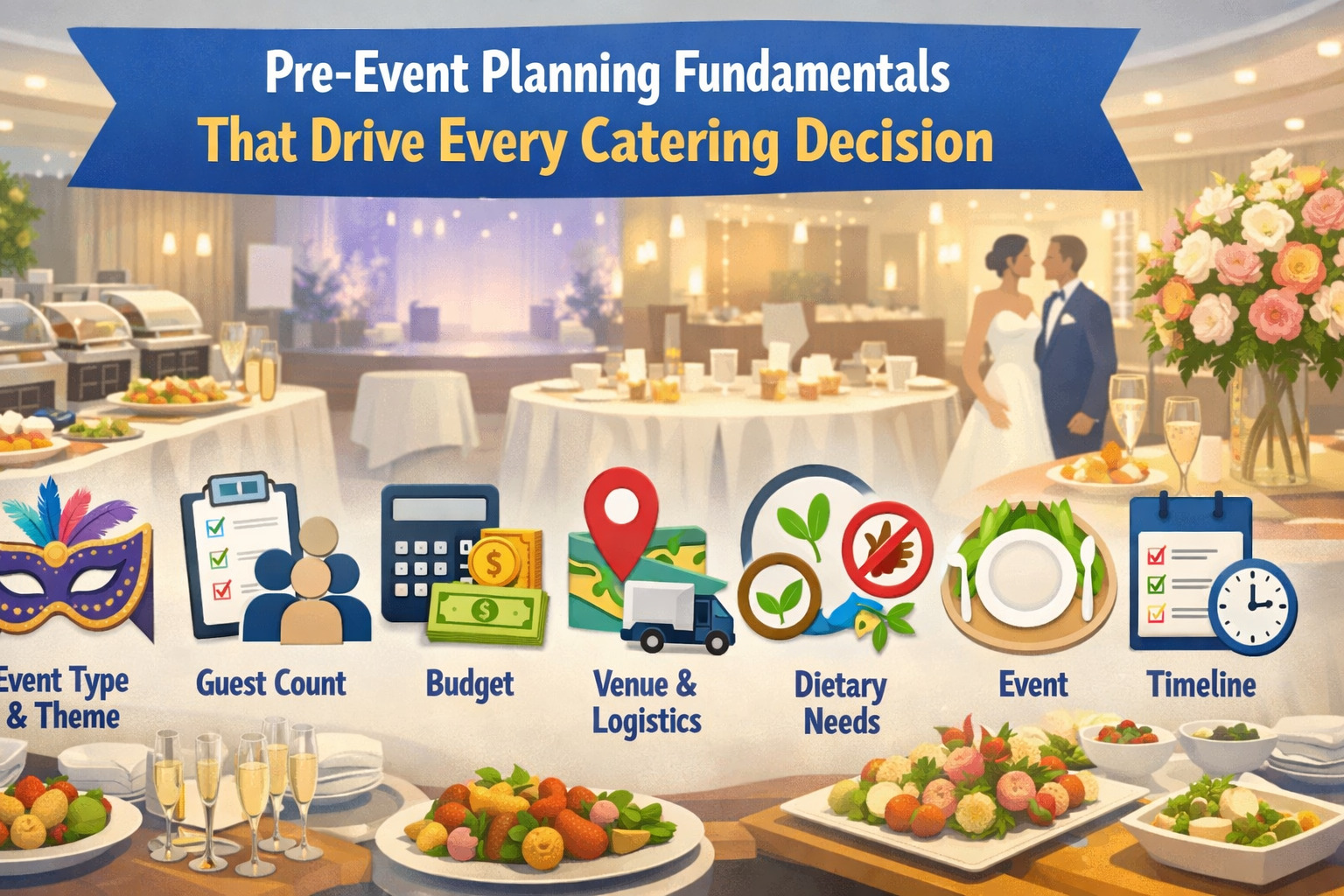
Before you compare menus or negotiate pricing, you need three anchors: guest count, venue constraints, and budget. These decide everything from staffing ratios to whether your caterer can safely execute your menu.
Start with guest count ranges, not perfection. Plan in tiers:
- Expected count (your most likely)
- Low/High range (for budgeting and ordering)
- Guaranteed minimum (often needed for contracts)
Then translate guest count into a service model. Buffet, plated, stations, family-style, cocktail heavy hors d’oeuvres—each requires different equipment, staffing, and time. A plated dinner with multiple courses can be stunning, but it’s sensitive to timing and staffing. A buffet can be efficient, but it requires guest flow planning and food temperature management.
Next, map out what the venue will and won’t allow:
- Can you cook onsite, or must food arrive fully prepared?
- Are there restrictions on open flame, fryers, propane, or grilling?
- Where is the loading zone, and how long is load-in allowed?
- Is there a required vendor list, COI requirements, or union labor rules?
Finally, set a budget that reflects reality:
- Food and beverages (including nonalcoholic drinks)
- Labor (setup, service, cleanup, chefs, bartenders)
- Rentals (tables, chairs, linens, glassware, flatware, hot boxes, tents)
- Fees (delivery, service charge, admin, travel)
- Contingency (typically 5–10% for changes and surprises)
Venue coordination: rules, layouts, and communication that prevent surprises

Venues in Delaware vary widely: historic properties, beaches, barns, ballrooms, private clubs, corporate offices, and public parks all have different operational realities. Your catering plan should start with the venue’s rulebook—written and unwritten.
Ask for venue policies in writing, then review them with your caterer. Key items to confirm:
- Kitchen access: Is there a commercial kitchen? A warming kitchen? Or no kitchen at all?
- Power availability: Number of circuits, outlet locations, generator rules, noise limits.
- Water access: Handwashing station requirements, potable water access, gray water disposal.
- Trash and recycling: Who provides bins, liners, and haul-away? Any sorting rules?
- Load-in/load-out: Elevator access, stairs, ramp availability, timing restrictions, parking.
- Noise and curfew: Impacts bar service and late-night snacks.
- Floor plan constraints: Fire lanes, tent placement, buffet/station placement, ADA access.
Layouts matter more than most hosts expect. A buffet placed in the wrong location can create lines that block doors, disrupt speeches, or cause crowding near the bar. A plated service requires staging space for plates and servers. Stations need spread-out power and traffic planning.
Use a simple “catering footprint” map with:
- Prep/staging area
- Beverage station(s)
- Bar placement
- Buffet/stations placement
- Bussing station (dirty dish landing zone)
- Trash location
- Staff entry/exit
Catering requirements for events in Delaware: what to verify early

This section is designed to help you plan responsibly without turning your event into a legal research project. Catering compliance often depends on where you’re serving, how long you’re operating, and what you’re doing onsite (cooking, reheating, alcohol, tents, etc.).
When in doubt, your best move is to confirm requirements with the right authority and document what you learned.
Food safety considerations and health department approval
Food safety isn’t just a caterer concern—it’s an event host concern, too, because delays or unsafe holding conditions can derail service.
For events that function like a temporary food operation, Delaware guidance describes temporary operations as limited-duration event food service. Delaware’s Business First Steps page notes that temporary permits are for operations “up to 14 days,” and that applications must be submitted at least 10 days prior to the event.
That means your timeline matters. Even if your caterer is handling the paperwork, you should confirm:
- Whether your event location or format triggers a temporary food permit
- Whether the caterer’s existing licensing covers the event
- What onsite requirements apply (handwashing, sanitation, temperature control)
Food safety items to confirm with your caterer:
- Hot holding plan (how hot food stays hot during transport and service)
- Cold holding plan (ice baths, refrigeration, insulated coolers)
- Allergen separation and labeling plan
- Leftover handling plan (what is discarded vs packaged; who is responsible)
Permits, venue approvals, and local authority coordination
Delaware isn’t one single jurisdictional experience. Cities and towns may have their own event rules, and certain venues (historic sites, parks, waterfront areas) may require additional approvals.
Your coordination checklist:
- Confirm the venue’s required approvals (and deadlines)
- Confirm whether the event needs a local permit (street closures, noise, tents, cooking equipment)
- Confirm who is responsible for each submission (host, venue, caterer, planner)
For tents and temporary structures, Delaware’s State Fire Marshal provides a tent permit process and application pathway.
If your event is in a city-managed facility or public space, confirm whether the city requires additional fire permits for cooking equipment, generators, or propane. (Many municipalities publish vendor checklists and fire safety requirements for events.)
Alcohol service considerations: licensing, approvals, and contracts
If alcohol is part of your plan, clarify who is legally providing it and how it will be served:
- Venue-provided bar (common at clubs and ballrooms)
- Caterer-provided bar (if licensed to do so)
- Separate licensed bar vendor
- Host-provided alcohol (often restricted by venue and event type)
Delaware’s Alcoholic Beverage Control Commissioner (OABCC) provides forms and application materials, including information relevant to on-premises retail licensing used by establishments such as restaurants and caterers.
For off-site catered events, Delaware Administrative Code includes specific rules—such as the event being tied to a written contract, potential allowance of a cash bar alongside a catered event, and an approval timeline (the rule text notes event approval no later than 20 days prior, along with submission items).
Key planning questions:
- Who holds the alcohol license/permit for this event?
- Is a cash bar allowed at this venue and for this event type?
- Are there restrictions on self-serve alcohol, BYOB, or champagne walls?
- What are the ID-check and underage prevention procedures?
Event catering compliance checklist Delaware

Use this event catering compliance checklist Delaware section as your working document. It’s written so you can copy/paste it into your planning notes and mark items complete.
Compliance and documentation checklist
Food and health department coordination
- Confirm whether the event qualifies as a temporary food service operation and what that implies.
- Confirm whether your caterer’s licensing/permits cover your specific location and format.
- Confirm the application timeline and who submits it (host/planner/caterer).
- Confirm onsite sanitation requirements: handwashing, dishwashing approach, waste water disposal.
- Confirm food temperature control plan for transport + holding + service.
Venue approvals
- Get venue rules in writing (kitchen use, flame/propane, load-in times, trash rules).
- Confirm required insurance levels and certificate of insurance (COI) wording.
- Confirm whether the venue requires a specific security plan for alcohol.
- Confirm venue staffing requirements (security, building engineer, attendant).
Fire and safety
- If using a tent, confirm whether a tent permit is required and submit on time.
- If using cooking equipment outdoors, confirm local fire safety requirements (extinguishers, generator placement, propane rules).
- Confirm egress routes are not blocked by buffet lines, bars, or décor.
- Confirm generator plan: placement, fuel storage, sound constraints, weather protection.
Alcohol service rules
- Confirm who holds the alcohol license/permit and whether off-site approval is required.
- Confirm the event is covered by a written catering/bar contract where applicable.
- Confirm ID check process and who is responsible.
- Confirm last call timing and venue curfew.
- Confirm transportation/waybill process if alcohol is transported by the licensed provider.
Vendor selection checklist: how to choose the right caterer (and avoid costly mismatches)
A caterer can be talented and still be wrong for your event. The right fit depends on your guest experience goals, venue constraints, and operational complexity.
Start by filtering for real capability:
- Do they regularly execute events at your size and style?
- Can they handle your service model (plated, stations, cocktail, buffet)?
- Can they support your location (beach, park, office building, historic property)?
- Do they provide rentals and staffing, or do you need separate vendors?
Questions to ask caterers during calls and tastings
Ask questions that reveal their operational thinking—not just menu creativity.
Operations and logistics
- How do you keep hot foods hot and cold foods cold during transport and service?
- What’s your plan if we lose power or weather shifts unexpectedly?
- Who is the day-of lead, and how many events do they manage at once?
- What’s your typical load-in time requirement?
Staffing and service
- What staffing ratios do you recommend for our service style?
- Do you staff bartenders, bussers, and a floor captain?
- How do you manage guest flow for buffet or stations?
Compliance and insurance
- What permits or approvals do you typically handle for events like ours?
- Can you provide COI showing general liability and (if applicable) liquor liability?
- If alcohol is served, who is responsible for licensing/permits and approvals?
Food and guest experience
- How do you accommodate allergies and dietary restrictions without isolating guests?
- Do you label allergens on buffets/stations?
- What’s included in tastings (and is it credited back if we book)?
Contract and proposal review checklist
Before you sign, ensure the proposal clearly states:
- Menu and portion standards (not just “passed apps”)
- Service style and staffing counts
- Rentals included vs excluded
- Setup and breakdown scope
- Taxes/fees/service charges/gratuity policy
- Payment schedule and cancellation terms
- Overtime rates and what triggers them
- Guest count deadline and overage policy
- Weather plan for outdoor events
- Responsibility matrix (who does what: host/venue/caterer)
Menu planning that feels thoughtful: dietary needs, allergens, and seasonal strategy
A great menu is not just delicious—it’s designed. It accounts for timing, temperature, guest flow, dietary restrictions, and seasonality.
Dietary restrictions and allergen planning
Delaware events often have a mix of guests: families, corporate teams, community groups, and multi-generational wedding parties. A menu that ignores dietary needs can create awkward moments, medical risks, and wasted spend.
Build a process:
- Collect dietary needs with RSVPs (and ask for severity of allergies).
- Categorize: allergy (medical), intolerance, preference.
- Decide on a labeling system for buffets/stations.
- Identify cross-contact risks (especially nuts, gluten, shellfish).
Practical ways to keep everyone included:
- Offer at least one satisfying main option that is naturally free of common allergens (not just salad).
- Create one “safe plate” pathway handled by a trained staff member.
- Avoid hidden allergens (sauces, garnishes, finishing oils).
- For plated meals, use color-coded place cards or seating chart notes for dietary plates.
Seasonal menu planning and local venue realities
Seasonality is about more than ingredients—it’s about conditions. Outdoor heat changes what holds well. Wind changes what can be served elegantly. Cooler months affect guest comfort and beverage choices.
Seasonal strategy examples:
- Warm weather: lighter sauces, sturdy greens, fewer mayonnaise-forward dishes outdoors.
- Cooler months: braised proteins, soups in cups, warm bread service, hot cocoa/coffee bar.
- Shoulder season: flexible menus that can pivot indoors/outdoors.
Also consider the venue:
- No kitchen: choose items that travel and hold well; avoid last-minute frying.
- Limited power: reduce dependence on electric warmers; use insulated holding equipment.
- Tight load-in: simplify courses; choose faster plating and fewer last-minute garnishes.
Buffet vs plated service: choosing the right format for your Delaware event
This decision has a bigger impact than most hosts realize. It changes staffing, timeline, rentals, food quantities, and guest experience.
Buffet service: best for flexibility, but requires flow control
Buffets can feel abundant and social, and they typically reduce per-guest labor costs. But they require intentional layout and temperature control.
Buffet checklist:
- Plan guest flow (two-sided buffet or multiple stations for larger groups).
- Avoid bottlenecks near doors, bars, or seating aisles.
- Assign staff to refresh food, clean spills, and manage utensils.
- Use clear allergen labeling and separate serving utensils.
- Confirm hot holding equipment capacity and power needs.
Buffet works well for:
- Nonprofit events where mingling matters
- Family-style celebrations
- Corporate events with flexible timing
Risks to manage:
- Longer lines if under-stationed
- Temperature drift if food sits too long
- Accessibility needs (height, mobility, assistance)
Plated service: elevated experience, but demands precision
Plated service feels formal and seamless—when staffing and timing are right. It’s sensitive to schedule delays, because your kitchen and service team are operating on a tight sequence.
Plated checklist:
- Confirm kitchen/staging space and plating area.
- Confirm staffing: servers, runners, captain, bussers.
- Confirm dietary plate tracking method.
- Build extra buffer time for speeches, first dances, or awards.
- Confirm timing between courses and how you’ll handle late guests.
Plated works well for:
- Weddings with a structured program
- Corporate galas and donor dinners
- Events where speeches need a quiet room
Risks to manage:
- Understaffed service causes slow or uneven pacing
- Tight venue rules may limit plating or reheating options
- Menu complexity increases execution risk
Alcohol and bar service planning: experience, safety, and smart control
Bar service is part hospitality, part logistics, part risk management. Your job is to create a great experience while keeping service controlled and compliant.
First, decide the bar model:
- Hosted open bar: best guest experience, highest cost.
- Limited bar: beer/wine + one signature cocktail.
- Cash bar: can reduce host cost but may be restricted by venue or event type; clarify early.
- Ticketed bar: controlled spend; guests exchange drink tickets.
For off-site catered events, Delaware rules include contract-based expectations and an approval timeline in the administrative code for off-site catered events.
Bar planning checklist
Experience
- Choose a drink menu that matches the event: crowd-pleasing, fast to serve.
- Plan nonalcoholic options that feel intentional (not just soda).
- Decide last call timing and communicate it subtly.
Operations
- Confirm bartender count based on guest count and bar complexity.
- Confirm glassware vs disposable; plan for backups.
- Confirm ice quantities (you almost always need more).
- Confirm bar layout: speed rails, garnish station, trash, bus tubs.
Safety and control
- Confirm ID check process and who performs it.
- Confirm how the team handles visibly intoxicated guests.
- Confirm transportation plan (rideshare codes, shuttle, designated driver messaging).
- Confirm liquor liability insurance where applicable.
Logistics planning for Delaware events: rentals, power, refrigeration, and coastal weather
Logistics is where catering goes from “menu” to “execution.” This is especially true for outdoor event catering, beach-adjacent venues, and any location without a full kitchen.
Rentals and equipment checklist
Confirm what your caterer provides vs what you must rent:
- Tables/chairs/linens
- Plates/flatware/glassware
- Serving ware: chafers, platters, utensils
- Beverage dispensers, coffee service equipment
- Handwashing station (if required)
- Lighting for buffet/stations and prep zones
- Trash cans, liners, and recycling bins
- Tent, flooring, fans/heaters depending on season
Ask vendors about delivery windows, setup responsibility, and pickup timing. Align all schedules so your space isn’t overloaded with separate drop-offs that block each other.
Power, refrigeration, and safe holding
If your menu requires refrigeration or hot holding, you need an equipment plan—not hope.
- Confirm refrigerated storage (onsite fridge space or rented refrigeration).
- Confirm hot holding (hot boxes, insulated cambros, chafers, warmers).
- Confirm generator needs if power is limited, and protect cords from foot traffic.
For tented events, confirm whether a tent permit is needed and what inspections apply.
Rain, wind, and coastal considerations
Delaware weather can change quickly, and coastal winds are not polite.
Plan for:
- Wind: weighted tent legs, protected buffet covers, heavier décor, secure signage.
- Rain: covered pathways for staff carrying food; protected prep zones.
- Heat: shade, fans, faster turnover for cold items, additional ice.
- Cold: warm beverages, covered service, heaters if allowed.
Staffing and service planning: event staffing ratios that feel smooth
Guests don’t remember your staffing spreadsheet. They remember whether they had to hunt for water, wait too long for food, or step around overflowing trash.
Staffing needs vary by service style, but your plan should cover these roles:
- Event captain/floor lead: runs timing and guest flow.
- Kitchen lead/chef: oversees food execution.
- Servers: plated service, stations, passed apps.
- Bartenders: bar service, restocking, ID checks.
- Bussers: clearing, resetting, trash management.
- Runner/support: restocking stations, moving items, solving problems.
Staffing planning checklist
- Define the service style and pace (fast cocktail vs formal plated).
- Confirm staffing counts in writing, including captain/lead.
- Confirm setup and breakdown labor is included (not just “service during event”).
- Confirm who handles water service and coffee service.
- Confirm who manages trash, recycling, and back-of-house cleanliness.
- Build buffer staffing if the venue has stairs, long carries, or limited access.
Budgeting and contract review checklist: protect the experience and your finances
Catering budgets can drift quietly. A few upgrades, an expanded bar, rental additions, and overtime can balloon costs.
Catering budget categories to track
- Food (apps, dinner, dessert, late-night)
- Nonalcoholic beverages
- Alcohol and bar labor
- Staffing and service labor
- Rentals and delivery fees
- Venue-required labor (security, building engineer)
- Taxes/fees/service charges
- Gratuity policy
- Contingency
Contract review checklist
Before signing:
- Confirm the menu is specific (counts, portions, brands if important).
- Confirm staffing numbers and roles.
- Confirm rental list line-by-line.
- Confirm timeline assumptions (when food must be served, not just “event time”).
- Confirm overtime trigger points and hourly rates.
- Confirm guest count deadline (and what happens if you exceed it).
- Confirm payment schedule and refund/cancellation terms.
- Confirm responsibility for leftover food and packaging.
- Confirm insurance requirements and COI delivery date.
90/60/30/7-day catering planning timeline breakdown
Use this catering timeline to stay ahead of deadlines and avoid last-minute stress.
90 days out: set the foundation
- Confirm guest count range and budget target.
- Select the caterer and lock the date with a deposit.
- Confirm venue rules and load-in/load-out plan.
- Decide service style (buffet vs plated vs stations).
- Decide alcohol approach and who provides bar service.
- Identify rentals you’ll need and any power/tent requirements.
60 days out: confirm compliance and logistics
- Confirm which permits/approvals apply and who is responsible.
- Confirm tent permit process if needed.
- Confirm menu direction and schedule tasting.
- Confirm rentals and preliminary floor plan.
- Confirm staffing approach and service timeline.
- Confirm bar plan and licensing/approval needs.
30 days out: finalize details that impact execution
- Finalize menu with dietary accommodations and allergen plan.
- Confirm final rental order (with 5–10% buffer on glassware).
- Confirm power, refrigeration, and waste plan.
- Confirm staffing numbers and event captain contact.
- Confirm printed signage needs (menu, allergens, bar options).
- Confirm rain/wind plan and decision trigger date.
7 days out: tighten the screws
- Provide final guest count (or confirm deadline).
- Confirm timeline: load-in, setup, service, breakdown, pickups.
- Confirm vendor COIs are delivered to venue.
- Confirm final payments and gratuity plan.
- Confirm day-of contacts list and communication method (group text).
- Confirm dietary list and seating notes.
Detailed day-of-event master checklist
This is the master list event professionals use to keep catering smooth and guests happy.
Before caterer arrival
- Confirm venue access and keys/entry process.
- Confirm load-in path is clear and elevator reserved if needed.
- Confirm power access and any reserved circuits.
- Confirm rain plan is ready to implement (tent sides, indoor backup).
- Confirm signage plan and where it will be placed.
During setup
- Confirm catering staging area and bussing station location.
- Confirm buffet/stations placement and guest flow.
- Confirm bar placement, ice storage, and trash placement.
- Confirm handwashing/sanitation setup if applicable.
- Confirm allergy-friendly pathway and labeling.
Pre-service checks
- Taste one bite of each key menu item (quality check).
- Confirm hot foods are held hot and cold foods are held cold.
- Confirm water stations are filled and visible.
- Confirm staffing is in position before guests enter.
- Confirm timeline cues: speeches, first dance, awards, program moments.
Service and guest experience
- Monitor lines at buffet/stations; adjust flow if needed.
- Confirm staff is resetting tables and clearing discreetly.
- Confirm trash is being managed before it becomes visible.
- Confirm dietary plates are delivered correctly and confidently.
- Confirm bar pace stays smooth; adjust staffing if lines grow.
Cleanup and breakdown
- Confirm leftover handling plan (what can be packaged; what must be discarded).
- Confirm rentals are consolidated for pickup.
- Confirm venue trash/recycling rules are followed.
- Confirm nothing is left behind in kitchen/staging areas.
- Do a final walk-through with venue rep.
Post-event wrap-up checklist: close the loop professionally
Post-event steps protect your deposit, your relationships, and your sanity.
- Confirm final invoice accuracy (overtime, extra rentals, added guests).
- Tip/gratuity distribution (if not included) and confirm who receives it.
- Collect COI and permit records into your event folder for future reference.
- Document what worked and what didn’t (menu, staffing, flow).
- Save vendor contacts and notes for next time.
- Leave reviews for vendors who performed well (it helps the local ecosystem).
- Send thank-you notes to key vendor contacts and venue staff.
Common mistakes to avoid (and what experienced planners do instead)
Even well-organized hosts make predictable mistakes. Here’s what to watch for.
Mistake 1: Choosing a menu that doesn’t match the venue
What happens: Beautiful dishes that require onsite finishing… at a venue with no kitchen and limited power.
Do instead:
- Choose dishes designed for transport and holding.
- Ask your caterer what items are “high risk” for your venue and season.
Mistake 2: Underestimating rentals and smallwares
What happens: Not enough water glasses, serving utensils, or coffee cups—forcing last-minute scrambling.
Do instead:
- Use a rental checklist tied to your menu and bar plan.
- Add buffers for glassware and ice.
Mistake 3: Not planning guest flow
What happens: Buffet line blocks entrances, bar line blocks the stage, stations crowd the dance floor.
Do instead:
- Map guest paths before you place food and bars.
- Use multiple smaller stations for larger crowds.
Mistake 4: Treating compliance as “the caterer’s problem”
What happens: A last-minute issue with approvals, tents, or alcohol responsibilities disrupts the event.
Do instead:
- Use the event catering compliance checklist Delaware section and assign owners/dates.
- Confirm submission deadlines early (some approvals require meaningful lead time).
Mistake 5: Not building time buffers
What happens: Speeches run long, service starts late, food quality suffers.
Do instead:
- Build schedule buffers for real life.
- Reduce menu complexity if the program is timing-heavy.
FAQ
Q1) What’s the first step in a catering checklist for Delaware events?
Answer: Start with guest count range, venue rules, and budget. Those three decisions determine service style, staffing, rentals, and what’s realistically executable at your location.
Q2) How early should I book a caterer for a Delaware wedding or corporate event?
Answer: For peak season weekends and popular venues, booking earlier is safer—especially if you need a full-service team plus rentals and bar. If you’re inside a tight timeline, focus on caterers who already have infrastructure and staffing depth.
Q3) Do all events require catering permits?
Answer: Not necessarily. Requirements can depend on event type, location, and what food operations happen onsite. Delaware resources describe temporary food establishment permits for limited-duration operations and include application timing considerations.
Q4) What’s the best way to handle food safety for outdoor event catering?
Answer: Design the menu for safe holding: minimize high-risk cold items in heat, use insulated transport, plan shade and ice, and confirm hot holding equipment capacity. Ask your caterer for their specific transport and holding plan.
Q5) How do I choose between buffet vs plated service?
Answer: Buffet is flexible and often more cost-efficient but needs strong flow control and temperature management. Plated feels elevated but demands tighter timing, more staff, and staging space. Let your venue constraints guide the decision.
Q6) What should I ask a caterer during a tasting?
Answer: Ask operational questions, not just flavor questions: holding methods, staffing ratios, rain plan, dietary accommodations process, and exactly what is included in service and rentals.
Q7) How do I plan for dietary restrictions and allergens?
Answer: Collect needs early, categorize by severity, require a clear labeling plan, and confirm how dietary plates are tracked and delivered. Avoid vague promises—get the process.
Q8) Can a caterer provide alcohol service at an off-site event?
Answer: It depends on licensing/approvals and event structure. Delaware’s Alcoholic Beverage Control Commissioner provides application materials, and Delaware’s administrative code includes specific provisions for off-site caterers and event approvals.
Q9) Do I need a tent permit for an outdoor event?
Answer: Some tented events may require permits or inspections depending on size and setup. Delaware’s State Fire Marshal provides a tent permit application pathway.
Q10) What staffing is “enough” for a smooth event?
Answer: It depends on service style and venue complexity. Plated service and passed hors d’oeuvres require more hands than a simple buffet. A captain/lead is one of the most valuable roles for keeping timing and quality consistent.
Q11) What should be in a catering contract?
Answer: Menu specifics, staffing counts, rentals, setup/breakdown scope, fees, payment schedule, cancellation terms, overtime rates, guest count deadlines, and responsibilities for alcohol and compliance items.
Q12) What’s the most overlooked item in a Delaware event catering checklist?
Answer: Power, refrigeration, and trash removal—especially outdoors or in venues without full kitchen infrastructure. These are the “unsexy” details that can derail service if ignored.
Conclusion
A successful event isn’t built on a great entrée alone. It’s built on clarity: clear guest counts, clear venue rules, clear compliance responsibilities, clear staffing, and a timeline that makes execution possible.
Use this catering checklist for Delaware events as your working system:
- Start with fundamentals (guest count, venue, budget)
- Confirm catering requirements for events in Delaware early and document responsibilities
- Choose a caterer based on operational fit—not just a pretty proposal
- Lock logistics, staffing, and a weather-ready plan
- Run a tight day-of checklist so guests only notice the hospitality—not the complexity