
Understanding Catering Contract Requirements in Delaware
May 6, 2026
Planning an event is exciting, but catering is one area where assumptions can become expensive. A written contract helps clarify menu details, guest count, pricing, payment terms, cancellation policies, staffing, setup, cleanup, venue rules, food safety, insurance, and each party’s responsibilities before the event day arrives.
For Delaware weddings, corporate events, school functions, nonprofit galas, private parties, and community gatherings, a catering agreement Delaware clients can understand is more than a formality. It is the working document that explains what will happen, what is included, what costs extra, and how changes will be handled.
A good catering service contract in Delaware should reduce surprises. It should tell you when the final guest count is due, how deposits work, what happens if the event is rescheduled, whether rentals are included, who handles trash removal, and whether the caterer can meet venue requirements.
This guide explains practical Catering Contract Requirements in Delaware so clients can review proposals more confidently, ask better questions, and protect their event budget. Disclaimer: This article is informational only and is not legal advice.
For questions about legal rights, contract enforceability, alcohol service, insurance obligations, or regulatory compliance, consult a qualified professional or the appropriate Delaware agency.
Why Catering Contracts Are Important
A catering contract protects both the client and the caterer by putting expectations in writing. Without a clear event catering agreement, one person may think staffing, rentals, linens, cleanup, or leftover packaging are included while the other person sees those items as separate charges.
That mismatch can create frustration, especially when the event date is close and options are limited. A strong contract also creates pricing clarity.
Catering costs may include food, labor, delivery, rentals, service charges, gratuity, taxes, overtime, equipment, setup time, breakdown time, and special menu requests. When these costs are listed clearly, clients can compare proposals more fairly and avoid choosing a caterer based only on a low starting price.
Timelines are another major reason Delaware catering contracts matter. Your contract should identify the event date, arrival time, service start time, meal period, cleanup deadline, and any venue access restrictions.
If a venue only allows vendors to load in during a narrow window, the caterer must know that in advance. A written agreement also helps prevent disputes. If a client requests additional appetizers, extends the bar service, adds guests, or changes the location, the contract should explain how those changes are approved and billed.
This is especially important for weddings, corporate events, and fundraisers where multiple people may be involved in decision-making. For a broader planning framework, this Delaware event catering checklist can help clients think through timing, staffing, venue logistics, and budget categories before signing.
What Should Be Included in a Delaware Catering Contract?
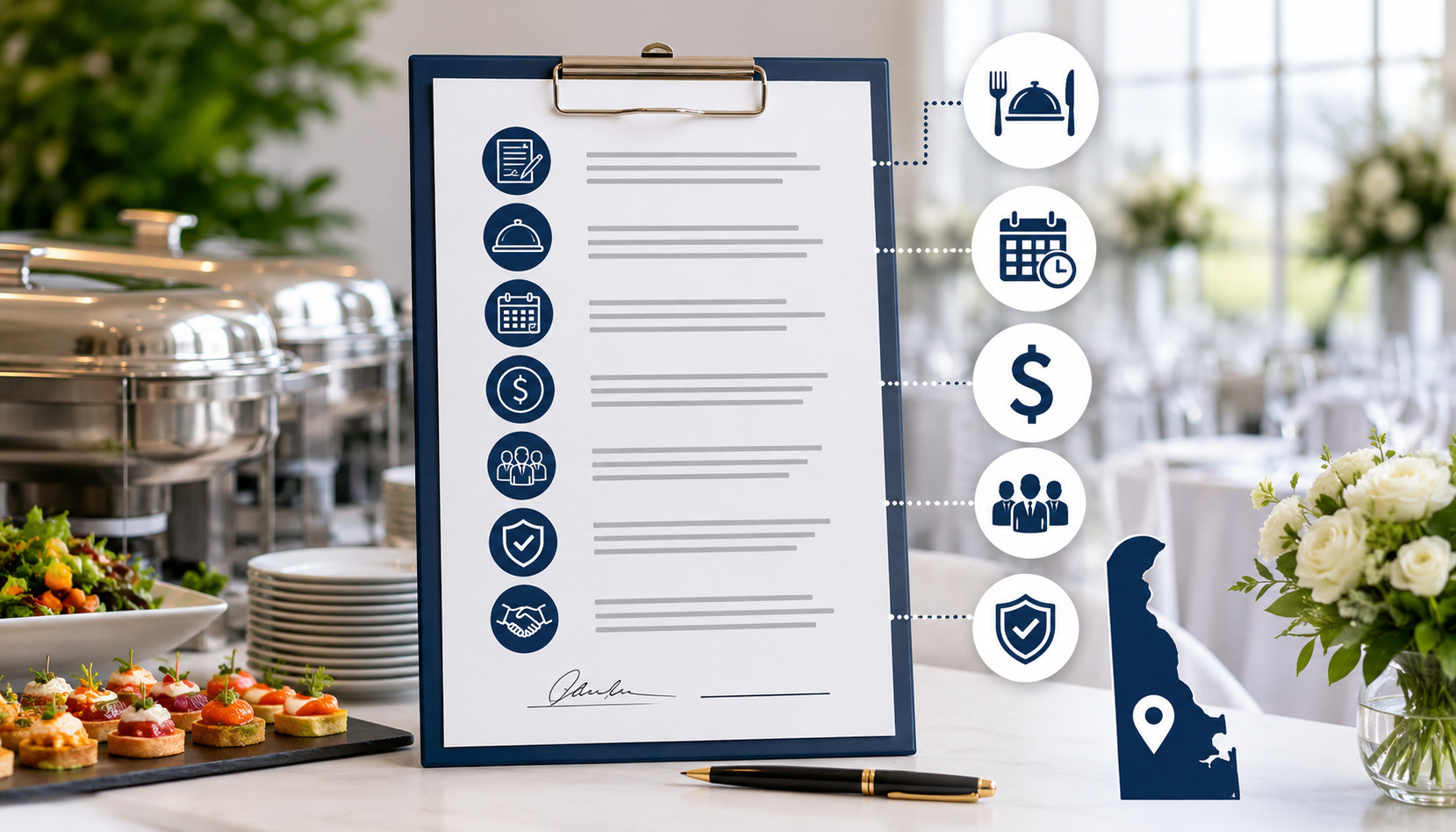
A Delaware catering contract should clearly describe the event, the services being purchased, the payment schedule, and the rules for changes. It should also explain responsibilities for food service, staffing, rentals, setup, cleanup, safety, insurance, and cancellation.
The goal is not to make the document complicated; the goal is to remove uncertainty before money changes hands. Clients should review every section before signing. Pay close attention to the difference between an estimate, proposal, invoice, and signed agreement.
A proposal may describe pricing and menu ideas, but the signed contract usually controls the actual obligations. The contract should identify both parties by legal or business name, include contact information, and state the event location.
It should also explain whether the caterer is preparing food off-site, using a venue kitchen, delivering drop-off catering, or providing full-service catering with staff.
Delaware food establishments are regulated through the Division of Public Health, and the state’s Business First Steps resource notes that the Division of Public Health issues permits for food establishments, including caterers. Clients should ask caterers about applicable food service permits, especially for public-facing or off-site events.
| Contract Section | What It Should Include | Why It Matters |
| Event details | Date, time, venue, address, guest count, event type | Prevents scheduling and service confusion |
| Service scope | Drop-off, buffet, plated, stations, bar, staffing, cleanup | Defines what the caterer is actually providing |
| Menu | Food items, dietary options, substitutions, allergens | Helps avoid menu disputes and guest issues |
| Pricing | Per-person cost, fees, taxes, rentals, labor, gratuity | Shows the real total cost |
| Deposits | Deposit amount, due date, refund rules | Clarifies what is required to reserve the date |
| Payment terms | Balance deadline, accepted payment methods, late fees | Protects both sides financially |
| Guest count | Estimated count, final guarantee deadline, overage rules | Helps the caterer buy and staff accurately |
| Cancellation | Refunds, non-refundable costs, rescheduling terms | Reduces confusion if plans change |
| Insurance | Liability coverage, certificate requirements, venue needs | Helps satisfy venue and risk requirements |
| Permits | Food service, temporary event, alcohol, venue approvals | Supports safer and more compliant planning |
| Setup and cleanup | Arrival, breakdown, trash, rentals, leftovers | Prevents event-day misunderstandings |
| Change orders | How revisions must be approved and priced | Keeps updates documented |
Event Details and Service Scope
The event details section should be specific. It should list the event date, venue name, venue address, start time, service time, expected end time, guest count, and main contact person.
For private residences, farms, schools, beaches, community centers, and historic venues, the contract should also address access, parking, power, water, kitchen availability, and weather planning. Service scope is equally important.
A drop-off lunch for a corporate meeting is very different from a staffed wedding reception with passed hors d’oeuvres, plated dinner, bar service, cake cutting, late-night snacks, and cleanup. The catering agreement should say exactly what service style is included.
The contract should also identify who handles setup and cleanup. Does the caterer set buffet tables? Will they place linens? Are they responsible for clearing plates? Do they remove trash? Are they returning rentals after the event? These details affect cost and staffing.
For larger events, ask whether there will be an event captain or lead staff member. This person can coordinate with the planner, venue manager, DJ, photographer, rental company, and client. Without a designated lead, small issues can turn into delays.
Menu, Guest Count, and Final Changes
Menu terms should be more detailed than a simple food list. The contract should describe appetizers, entrees, sides, desserts, beverages, late-night items, children’s meals, vendor meals, and dietary accommodations.
If substitutions are allowed, the agreement should explain when and how they may happen. Guest count rules are one of the most important catering contract terms.
Most caterers need a final guaranteed count before the event so they can order food, schedule staff, prepare equipment, and plan portions. If fewer guests attend than expected, the client may still owe payment based on the guaranteed count.
Last-minute increases should also be addressed. A caterer may be able to accommodate a small increase, but additional guests can affect food quantity, rentals, staffing, service timing, and cost. The contract should say whether increases are allowed after the final count deadline and how they are billed.
Dietary restrictions should be documented carefully. Vegetarian, vegan, gluten-sensitive, dairy-free, nut-free, shellfish-free, religious dietary needs, and severe allergies should be communicated early. The contract should explain whether separate preparation, labeling, or individually packaged meals are included.
Pricing, Deposits, and Payment Terms
Catering payment terms should be easy to follow. The contract should state the total estimated price, deposit amount, payment deadlines, final balance due date, accepted payment methods, and any late payment consequences.
If pricing depends on the final guest count, the agreement should explain how the final invoice will be calculated. A catering deposit agreement usually reserves the event date and compensates the caterer for planning time, menu work, administrative work, and lost booking opportunities.
Some deposits are refundable within a limited window, while others are partially or fully non-refundable. The contract should explain this clearly. Clients should also review taxes, service charges, gratuity, labor charges, delivery fees, administrative fees, rental charges, equipment fees, overtime rates, travel fees, and credit card processing fees.
A low food price may not reflect the final event cost once these items are added. Refund rules should match the cancellation policy. If the event is canceled after the caterer has ordered food, scheduled staff, rented equipment, or turned away other bookings, some costs may not be recoverable.
Cancellation, Rescheduling, and Refund Policies
A catering cancellation policy should explain what happens if the client cancels, the venue cancels, severe weather affects the event, or the date must be changed.
This section is especially important for outdoor events, coastal events, backyard receptions, school events, and nonprofit fundraisers that depend on attendance, weather, or outside approvals. The policy should identify cancellation deadlines and refund rules.
For example, the contract may state that cancellation before a certain date results in a partial refund, while cancellation close to the event may require payment of non-refundable costs. These costs can include food orders, rentals, staffing commitments, administrative work, permits, planning time, and special-order items. Rescheduling terms should also be clear.
Some caterers will apply a deposit to a new date if they are available, while others may charge a rescheduling fee or treat the change as a cancellation. If the new date has different pricing, staffing needs, or menu costs, the contract should explain how those differences are handled.
Weather provisions are important for outdoor Delaware events. A contract may require the client to provide tents, flooring, covered service areas, refrigeration access, generators, or an indoor backup plan. If weather makes safe food service impossible, the contract should explain who decides whether service can continue.
Venue changes should be documented. Moving from a banquet hall to a private residence can change power needs, equipment needs, staffing, travel time, kitchen access, and cleanup responsibilities.
Food Safety, Permits, and Insurance Considerations

Food safety, permits, and insurance are major parts of Catering Contract Requirements in Delaware. Clients do not need to become regulatory experts, but they should ask practical questions before hiring a caterer. A professional caterer should be able to explain how food will be prepared, transported, held, served, and cleaned up.
Delaware’s food establishment plan review materials state that Delaware Health and Social Services has authority to regulate food establishments, including caterers, temporary food vendors, restaurants, grocery stores, and other operations handling food for human consumption.
This is why clients should ask whether the caterer is operating from an appropriate permitted facility and whether additional event approvals may be needed. Food service permits may depend on the type of event, location, service model, and whether food is sold or served to the public.
The Delaware Business First Steps page encourages anyone opening or expanding a food establishment to contact the Office of Food Protection early to understand licensing procedures. The contract should also address food safety responsibilities at the event site.
This may include refrigeration, hot holding, cold holding, covered service areas, handwashing access, clean water, trash disposal, and safe leftover handling. Insurance is another key issue. Many venues require caterers to provide a certificate of insurance before the event.
The contract should say who must provide insurance documents, when they are due, and whether the venue must be listed in a specific way. For more detail on what clients can ask for, this guide to licensed caterers in Delaware covers documents, food safety questions, insurance, and contract review points.
Liability and Insurance
Catering liability insurance matters because food service involves people, property, equipment, staff, heat, sharp tools, spills, and time-sensitive handling. A guest could slip near a beverage station, a staff member could damage venue property, or a food service issue could create a claim.
Insurance language helps clarify how risk is handled. The contract should state whether the caterer carries general liability insurance, workers’ compensation coverage when applicable, vehicle coverage for delivery, and liquor liability coverage if alcohol service is involved.
The exact coverage needed may depend on the event, venue, and services provided. Venues often require a certificate of insurance. Some may ask to be named as an additional insured. If that is required, the client should send the venue’s insurance instructions to the caterer before signing or soon after booking.
Insurance terms should also clarify responsibility for rentals and equipment. If a guest breaks glassware, a rental item is missing, or a table is damaged, the agreement should say who is responsible for replacement or repair charges.
Alcohol and Beverage Service Terms
Alcohol and beverage service should never be handled casually. If a caterer, bartender, venue, or client is involved in serving alcohol, the contract should clearly explain who is providing the alcohol, who is serving it, who is checking identification, what service hours apply, and what happens if a guest appears intoxicated.
The Delaware Office of the Alcoholic Beverage Commissioner handles liquor license applications, modifications, inspections, renewals, hearings, and related alcohol regulatory matters. Because alcohol rules can be situation-specific, clients should confirm requirements directly with the caterer, venue, and appropriate agency when alcohol will be served.
The event vendor contract should also address corkage, mixers, ice, glassware, bar rentals, bartender fees, service limits, last call, and whether leftover alcohol may be removed. If the venue has preferred bartenders or specific alcohol service rules, those terms should be incorporated into the catering agreement.
For private events, clients should be careful about assuming that “bring your own alcohol” automatically works. Venue rules, caterer policies, insurance requirements, and alcohol regulations may affect what is allowed.
Staffing, Rentals, Setup, and Cleanup Terms
Staffing can determine whether an event feels smooth or chaotic. The catering service terms should say how many servers, bartenders, chefs, attendants, delivery staff, or captains are included.
It should also explain the scheduled staff arrival time, service period, breakdown time, and overtime rate. A buffet may require fewer staff than a plated dinner, but it still needs attention. Staff may be needed to replenish food, monitor temperature, clear plates, manage beverage stations, guide guests, and keep the service area clean.
Plated service generally requires more labor because timing, table service, and clearing are more involved. Rentals should be listed clearly. Do not assume the caterer provides tables, chairs, linens, napkins, china, flatware, glassware, serving pieces, chafing dishes, trays, coffee urns, bars, or kitchen equipment.
Some caterers include certain items, some coordinate rentals for a fee, and others expect the client or venue to provide them. Setup terms should describe what the caterer will do before guests arrive.
This may include arranging buffet tables, setting chafers, placing food labels, setting coffee stations, preparing bar areas, or coordinating with the planner. Cleanup terms should explain whether the caterer removes food waste, clears tables, bags trash, returns rentals, wipes service areas, or leaves trash in a venue-designated location.
Leftovers should also be addressed. Food safety rules and caterer policies may limit what can be packed, how long food can sit out, and whether leftovers can be taken home. The contract should explain this so guests and hosts do not make unsafe assumptions.
Venue Rules and Vendor Coordination
Venue rules can directly affect catering. A beautiful space may have limited kitchen access, strict load-in times, no open-flame policies, limited refrigeration, narrow elevators, restricted parking, or required cleanup deadlines.
If the caterer does not know these details early, the event plan may be unrealistic. The client should provide the caterer with venue rules before the contract is finalized.
These may include insurance requirements, vendor arrival windows, loading dock instructions, kitchen rules, trash disposal procedures, power availability, water access, floor protection requirements, alcohol policies, and preferred vendor rules.
Vendor coordination is also important. The caterer may need to work with the venue manager, rental company, florist, planner, entertainment team, photographer, and transportation provider. A delay in one area can affect food service timing.
For example, if speeches run long, plated dinner timing may need to shift. The contract should identify who is responsible for communicating final logistics. In some events, the planner handles vendor coordination. In smaller private events, the host may be the main contact.
The caterer should know who has authority to approve timeline changes, extra charges, or service adjustments. Outdoor venues need extra attention. The contract should address rain plans, wind, tenting, lighting, refrigeration, generator power, bugs, uneven ground, and access for delivery vehicles.
These details can affect food safety and guest comfort. For menu and vendor selection planning, this article on choosing the right Delaware caterer can help clients compare experience, pricing, and service fit.
Common Catering Contract Mistakes to Avoid

One common mistake is signing too quickly. Clients may focus on menu excitement and skip the less glamorous terms, such as cancellation, overtime, rentals, final guest count, and cleanup. Those sections often have the biggest financial impact.
Another mistake is assuming rentals are included. A proposal may show food and staff but not tableware, linens, glassware, serving equipment, or tables. If those items are not listed, ask whether they are included, optional, or handled through a rental company.
Ignoring cancellation terms is also risky. Life events, weather, venue problems, emergencies, and attendance changes can affect plans. A catering cancellation policy should be reviewed before paying a deposit, not after a problem occurs.
Clients also forget to confirm staffing. A buffet for 150 guests with too few attendants can create long lines and messy service areas. A plated dinner without enough servers can run late. Staffing should match guest count, service style, venue layout, and event timeline.
Another mistake is missing the final guest count deadline. If the deadline passes, the caterer may order food and schedule labor based on the last confirmed number. Lowering the count after that point may not reduce the bill.
Failing to document changes is also common. Text messages, phone calls, and casual conversations can create confusion. Any change to menu, price, date, guest count, venue, service style, rentals, or staffing should be confirmed in writing.
Questions to Ask Before Signing a Catering Agreement
Before signing a catering agreement, ask direct questions that reveal what is included, what is extra, and what must happen before the event. Good caterers expect these questions and should be able to answer clearly. Start with pricing.
Ask what is included in the quoted price and what could increase the final bill. Confirm whether taxes, service charges, gratuity, delivery, rentals, labor, overtime, and administrative fees are included.
Ask about service scope. Will the caterer deliver food only, set up a buffet, provide full-service staff, manage the bar, clear tables, cut cake, package leftovers, or remove trash? Each task affects staffing and cost. Ask about menu changes.
When are selections final? Can you adjust dietary meals? What happens if an ingredient becomes unavailable? Are substitutions equal in price, or can they change the total? Ask about insurance and permits. Can the caterer provide a certificate of insurance? Does the venue require specific coverage? Is the caterer operating from a permitted food establishment? Are any temporary event or alcohol approvals needed? Ask about cancellation and rescheduling. What part of the deposit is refundable? What costs become non-refundable? Can the deposit transfer to a new date? What happens if the venue closes or severe weather affects the event? Useful questions include:
- What is the final guest count deadline?
- What is the deposit amount, and is it refundable?
- When is the final balance due?
- What rentals are included?
- How many staff members are included?
- What are the overtime fees?
- Who handles setup and cleanup?
- Can you meet my venue’s insurance requirements?
- What happens if my event is rescheduled?
- How are menu changes documented?
- Who is the day-of contact?
- What food safety practices apply for outdoor service?
For a deeper contract-focused resource, this page on Delaware catering contracts offers additional context on written terms, guest count guarantees, deposits, and service responsibilities.
FAQs About Catering Contract Requirements in Delaware
What should be included in a catering contract?
A catering contract should include the event date, location, guest count, menu, service style, staffing, setup, cleanup, pricing, deposit, payment schedule, cancellation policy, insurance terms, permit responsibilities, and change procedures.
Are deposits usually required for catering services?
Yes, deposits are commonly required to reserve the event date. The contract should state the deposit amount, due date, accepted payment method, and refund rules.
What happens if my guest count changes?
Most contracts include an estimated guest count and a final guaranteed count deadline. If the count increases, the final price may increase. If it decreases after the deadline, the client may still owe based on the guaranteed number.
Should catering contracts include cancellation terms?
Yes. Cancellation terms should explain refund rules, non-refundable costs, deadlines, rescheduling options, weather issues, emergencies, and what happens if the event cannot proceed as planned.
Do caterers need insurance?
Many professional caterers carry insurance, and many venues require proof of coverage. Clients should ask whether the caterer can provide a certificate of insurance before the event.
Is a catering contract legally binding?
A signed catering contract may create enforceable obligations, depending on the terms and circumstances. Clients should speak with a qualified professional if they have legal concerns.
Conclusion
Understanding Catering Contract Requirements in Delaware helps clients avoid surprises, protect their budget, and plan smoother events. A strong contract should clarify the menu, guest count, pricing, deposits, payment terms, cancellation policy, staffing, rentals, setup, cleanup, venue rules, food safety, insurance, and written responsibilities. Before signing, read every section carefully. Ask questions, compare line-item pricing, confirm venue requirements, and make sure all changes are documented in writing. A catering contract is not just paperwork. It is the agreement that turns your event expectations into clear responsibilities, helping the client, caterer, venue, and vendors work from the same plan.